Jakuren: The First Day of Winter
Posted: December 22, 2011 Filed under: English, Jakuren, Japanese Comments Off on Jakuren: The First Day of Winter
Poems of Mediaeval Japan by
Jakuren (Buddhist monk and poet: 1139-1202)
* Transliterated Japanese on the left *
yomosugara throughout the night
kusa no iori ni we kept the brushwood burning
shiba taite in my lowly hut,
katarishi koto o and the words that we exchanged
itsuka wasuren I never shall forget
* * *
miyamabi ni deep in this mountain
fuyugomorisuru I keep the winter indoors:
oi no mi o who would care to call
tare ka towamashi on so aged a body,
kimi naranaku ni were it not for you?
* * *
izukuyori you found a path in my dream
yoru no yumeji o the mountain
tadorikoshi is deeply in snow now
miyama wa imada
yuki no fukakini
* * *
ikanishite wondering how you
kimi imasuran have been of late, as the breath
konogoro no of snow in the wind
yukige no kaze no blows colder every day
hibi ni samuki ni
* * *
Rin Ishigaki: “Myself: a far-off island”
Posted: December 8, 2011 Filed under: English, Japanese, Rin Ishigaki Comments Off on Rin Ishigaki: “Myself: a far-off island”_____
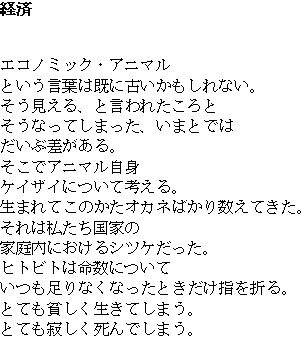
The Economy
The phrase ‘economic animal’
I suppose is already fairly old.
Quite a gap exists between
The time when they said we seem that way
And now when we are that way.
Now then we economic animals
Will think about the economy.
From the time that I was born I’ve just been counting money.
That was what we were taught in the home
By the state.
People only count the time they have left
When it has started to run out.
We live terribly impoverished lives.
We die terribly lonely deaths.
(1987)
_____
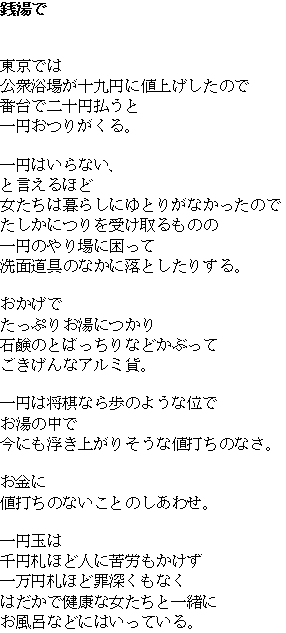
At the Bathhouse
In Tokyo
At the public bathhouse the price went up to 19 yen and so
When you pay 20 yen at the counter
You get one yen change.
Women have no leeway in their lives
To be able to say that
They don’t need one yen
And so though they certainly accept the change
They have no place to put it
And drop it in between their washing things.
Thanks to that
The happy aluminium coins
Soak to their fill in hot water
And are splashed with soap.
One yen coins have the status of chess pawns
So worthless that they’re likely to bob up even now
In the hot water.
What a blessing to be of no value
In monetary terms.
A one yen coin
Does not distress people in the way a 1,000 yen note does
Is not as sinful as a 10,000 yen note
The one yen coin in the bath
With healthy naked women.
(1968)
_____
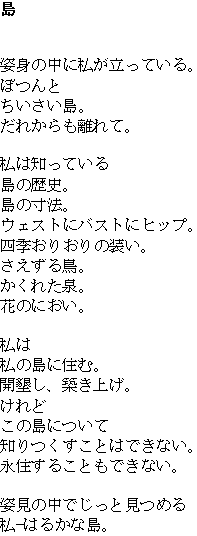
Island
I am standing in a large mirror.
A solitary
Small island.
Separated from everyone.
I know
The history of the island.
The dimensions of the island.
Waist, bust and hips.
Seasonal dress.
The singing of birds.
The hidden spring.
The flower’s fragrance.
As for me
I live on the island.
I have cultivated it, built it.
Yet
It is impossible to know
Everything about the island.
Impossible to take up permanent residence.
In the mirror staring at
Myself: A far-off island.
(2004)
_____
Rin Ishigaki (Ishigaki Rin in Japanese name-order)
was born in Tokyo in 1920 and died in 2004.
She worked for four decades as a bank clerk, kept
house, cooked, and cared for ageing parents.
Her first book of poems was published in 1959.
Without pretension or preciousness, her poems
are well-liked by people who might normally
steer clear of poetry!
These are thoughtful statements about ordinary life
– written in simple, straightforward Japanese –
and are sometimes used to teach the language to children,
as well as to foreign students.
_____
Translations from Japanese:
Leith Morton
Ishigaki’s original three Japanese poems are featured below.
_____
Inuo Taguchi: “Morning Discussion”
Posted: December 8, 2011 Filed under: English, Inuo Taguchi, Japanese Comments Off on Inuo Taguchi: “Morning Discussion”_____
Inuo Taguchi
MORNING DISCUSSION
I had a strange dream.
An airplane –
it doesn’t fall straight down
but crashes horizontally.
“Don’t ask me how.
It happened in my dream.”
Now, in this ‘modern’ world
it’s common for vertical things to change into horizontal.
So it’s nothing to make a fuss about
that a plane should crash horizontally.
“Why are you making such a big deal out of it?
Nonsense is commonsense nowadays.”
Don’t worry. If you tip over you glass, wine will spill out.
If you let go of a knife, it’ll fall straight down.
Our world, as ever,
obeys divine providence.
What doesn’t obey it is your dream and –
“No, don’t turn on the television.
It’s never told us good stories. It never will.”
I am listening to the morning discussion half-heartedly,
for I only want to think about poetry.
But my thoughts suddenly turn to the grasslands of
Kharakhorum.
There, too, are things that should be floating in air
floating in air?
There, too, is what should be falling falling?
Do things never crash horizontally?
Is what should be landing landing
and what should be ascending ascending?
Suddenly I feel like confirming it
and begin to be restless.
The soul begins slowly spiraling.
A kitchen kettle
begins honking like a horn.
*
from: Hush-a-bye
(2004)
Translation from Japanese:
William I. Elliott and Kazuo Kawamura
The original Japanese poem is featured below.
_____

_____
Inuo Taguchi was born in 1967 in Tokyo, Japan. His pen-
name, Inuo, means Dog-Man. He began to write poetry
in his early twenties and his first book came out in 1995.
He has been described as having a “self-less voice” as a poet,
meaning he is off to the side, even out of the “story”
– and often his poems are little stories.
At festivals he reads his poems aloud – usually barefoot.
His poems have been translated into Turkish – among a bunch
of languages.
He muses: “I feel that poetry must strive to open giant
air holes in human consciousness.”
 Zócalo Poets