Election Day poems: “Democracy” X 3
Posted: November 4, 2014 Filed under: English | Tags: Election Day poems Comments Off on Election Day poems: “Democracy” X 3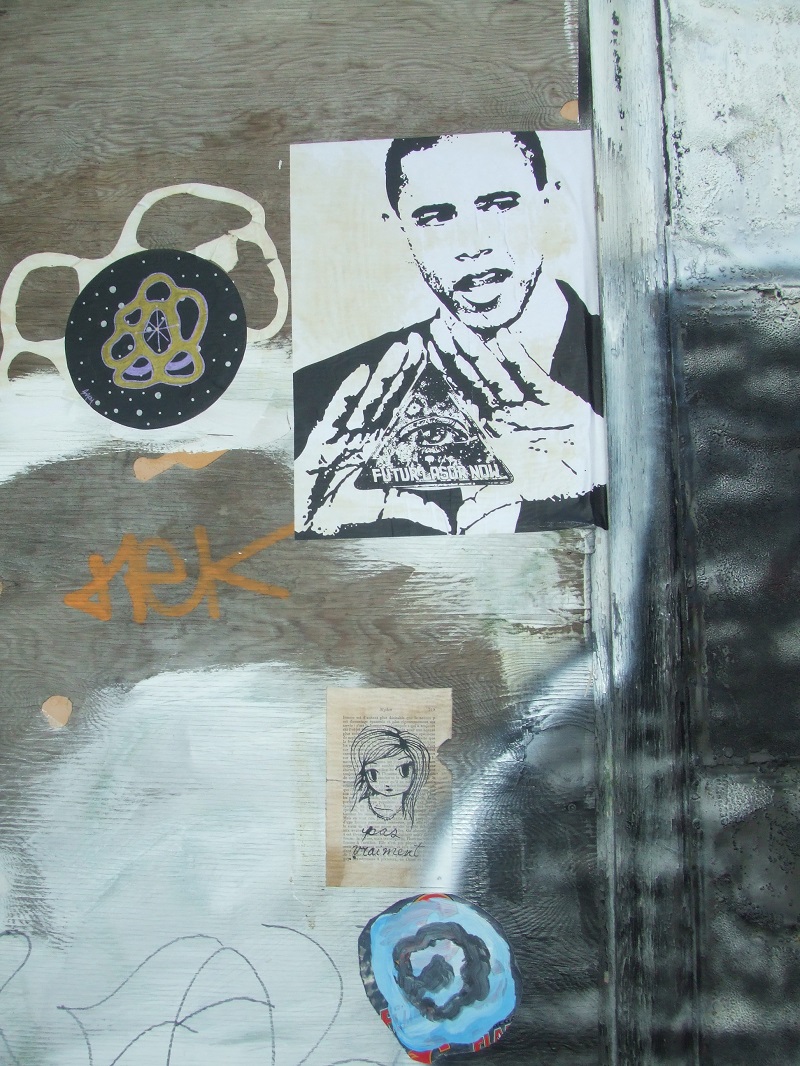
Today, the first Tuesday after the first Monday in November, is traditionally “Election Day” in the U.S.A. Following, some poems to ponder…
Langston Hughes
(1902-1967)
Democracy
(1949)
.
Democracy will not come
Today, this year
Nor ever
Through compromise and fear.
I have as much right
As the other fellow has
To stand
On my two feet
And own the land.
I tire so of hearing people say,
Let things take their course.
Tomorrow is another day.
I do not need my freedom when I’m dead.
I cannot live on tomorrow’s bread.
Freedom
Is a strong seed
Planted
In a great need.
I live here, too.
I want freedom
Just as you.
……….
Dorianne Laux (born 1952, Augusta, Maine, U.S.A.)
Democracy
.
When you’re cold—November, the streets icy and everyone you pass
homeless, Goodwill coats and Hefty bags torn up to make ponchos—
someone is always at the pay phone, hunched over the receiver
spewing winter’s germs, swollen lipped, face chapped, making the last
tired connection of the day. You keep walking to keep the cold
at bay, too cold to wait for the bus, too depressing the thought
of entering that blue light, the chilled eyes watching you decide
which seat to take: the man with one leg, his crutches bumping
the smudged window glass, the woman with her purse clutched
to her breasts like a dead child, the boy, pimpled, morose, his head
shorn, a swastika carved into the stubble, staring you down.
So you walk into the cold you know: the wind, indifferent blade,
familiar, the gold leaves heaped along the gutters. You have
a home, a house with gas heat, a toilet that flushes. You have
a credit card, cash. You could take a taxi if one would show up.
You can feel it now: why people become Republicans: Get that dog
off the street. Remove that spit and graffiti. Arrest those people huddled
on the steps of the church. If it weren’t for them you could believe in god,
in freedom, the bus would appear and open its doors, the driver dressed
in his tan uniform, pants legs creased, dapper hat: Hello Miss, watch
your step now. But you’re not a Republican. You’re only tired, hungry,
you want out of the cold. So you give up, walk back, step into line behind
the grubby vet who hides a bag of wine under his pea coat, holds out
his grimy 85 cents, takes each step slow as he pleases, releases his coins
into the box and waits as they chink down the chute, stakes out a seat
in the back and eases his body into the stained vinyl to dream
as the chips of shrapnel in his knee warm up and his good leg
flops into the aisle. And you’ll doze off, too, in a while, next to the girl
who can’t sit still, who listens to her Walkman and taps her boots
to a rhythm you can’t hear, but you can see it—when she bops
her head and her hands do a jive in the air—you can feel it
as the bus rolls on, stopping at each red light in a long wheeze,
jerking and idling, rumbling up and lurching off again.
*
from: Facts About The Moon, copyright © 2007, Dorianne Laux
……….
Leonard Cohen
(Songwriter/singer, born 1934, Montreal, Canada)
Democracy
.
It’s coming through a hole in the air,
from those nights in Tiananmen Square.
It’s coming from the feel
that this ain’t exactly real,
or it’s real, but it ain’t exactly there.
From the wars against disorder,
from the sirens night and day,
from the fires of the homeless,
from the ashes of the gay:
Democracy is coming to the U.S.A.
.
It’s coming through a crack in the wall;
on a visionary flood of alcohol;
from the staggering account
of the Sermon on the Mount
which I don’t pretend to understand at all.
It’s coming from the silence
on the dock of the bay,
from the brave, the bold, the battered
heart of Chevrolet:
Democracy is coming to the U.S.A.
.
It’s coming from the sorrow in the street,
the holy places where the races meet;
from the homicidal bitchin’
that goes down in every kitchen
to determine who will serve and who will eat.
From the wells of disappointment
where the women kneel to pray
for the grace of God in the desert here
and the desert far away:
Democracy is coming to the U.S.A.
.
Sail on, sail on
O mighty Ship of State!
To the Shores of Need
Past the Reefs of Greed
Through the Squalls of Hate
Sail on, sail on, sail on, sail on.
.
It’s coming to America first,
the cradle of the best and of the worst.
It’s here they got the range
and the machinery for change
and it’s here they got the spiritual thirst.
It’s here the family’s broken
and it’s here the lonely say
that the heart has got to open
in a fundamental way:
Democracy is coming to the U.S.A.
.
It’s coming from the women and the men.
O baby, we’ll be making love again.
We’ll be going down so deep
the river’s going to weep,
and the mountain’s going to shout Amen!
It’s coming like the tidal flood
beneath the lunar sway,
imperial, mysterious,
in amorous array:
Democracy is coming to the U.S.A.
Sail on, sail on …
.
I’m sentimental, if you know what I mean
I love the country but I can’t stand the scene.
And I’m neither left or right
I’m just staying home tonight,
getting lost in that hopeless little screen.
But I’m stubborn as those garbage bags
that Time cannot decay,
I’m junk but I’m still holding up this little wild bouquet:
Democracy is coming to the U.S.A.
……….
José Guadalupe Posada: the ‘calaveras’ of a Mexican master of social reportage and satire
Posted: November 2, 2014 Filed under: Alexander Best, IMAGES, Retratos por José Guadalupe Posada | Tags: Day of the Dead (Mexico) Comments Off on José Guadalupe Posada: the ‘calaveras’ of a Mexican master of social reportage and satire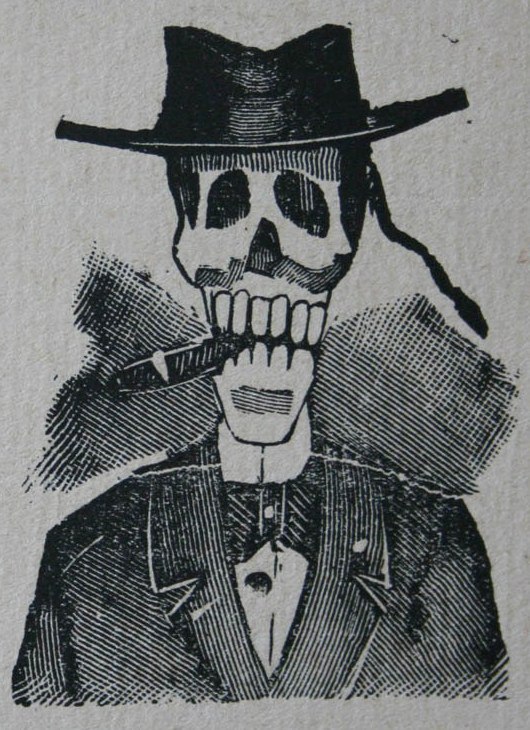
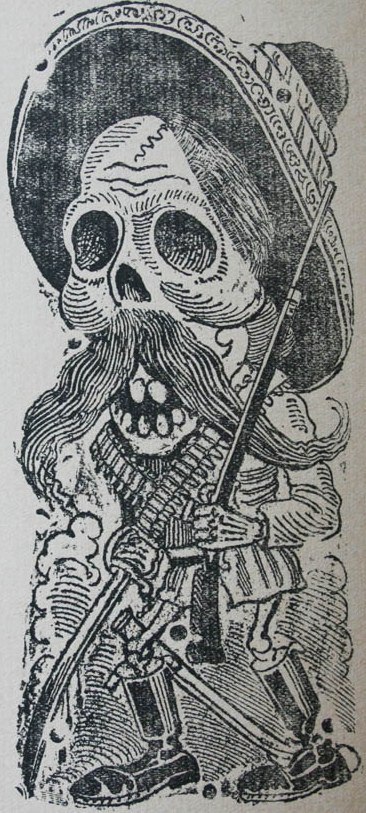
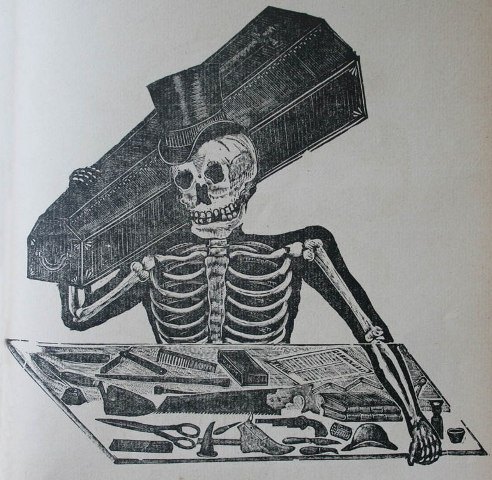
The etchings of José Guadalupe Posada (1852-1913) demonstrated a worldview that was, and often still is, profoundly Mexican. A commercial illustrator who also printed political broadsides, Posada invented the ‘calavera’ portrait. Calavera means skull, and by extension, skeleton. Aspects of the nation’s Indigenous heritage (skulls and death-goddesses were central to Aztec and Maya cultures) plus its Spanish cultural inheritance (death-oriented monastic orders, the ‘dance of death’ and ‘memento mori’ traditions) combine in Posada’s rustic yet sophisticated prints to give us the flavour of the average Mexican’s stoical yet humorous appreciation of Death.
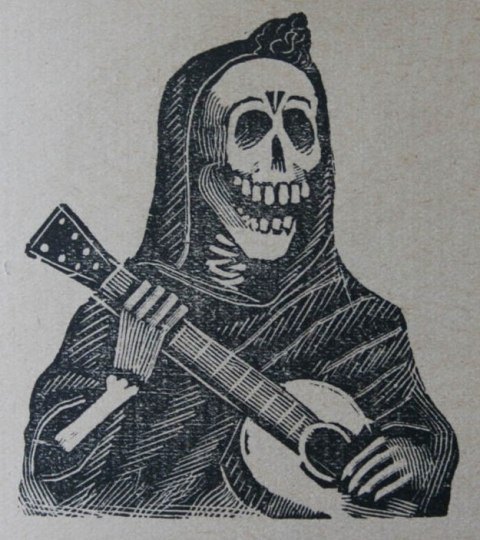
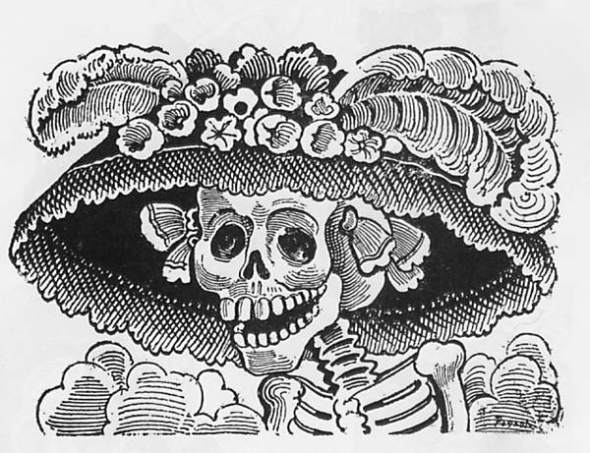
La Catrina_zinc etching by J.G. Posada
……….
A Sincere Tale for The Day of The Dead :
“ Lady Catrina goes for a stroll / Doña Catrina da un paseo ”
*
“¡ Santa Mictecacihuatl !
These Mandible Bone-nix (Manolo Blahniks) weren’t meant for
The Long Haul – certainly not worth the silver I shelled out for ’em ! ”
Thus spoke that elegant skeleton known as La Catrina.
And she clunked herself down at the stone curb, kicking off the
jade-encrusted, ocelot-fur-trimmed high-heel shoes.
“ Well, I haven’t been ‘bone-foot’ like this since I was an escuincle. ”
She chuckled to herself as she began rummaging through her Juicy handbag.
Extracting a shard of mirror, she held it up to her face – a calavera
with teardrop earrings grinned back at her. ¡Hola, Preciosa!
she said to herself with quiet pride. She adjusted her necklace of
cempasúchil blossoms and smoothed her yellow-white-red-and-black
designer-huipil.
*
Just then a lad and lassie crossed her path…
“ Yoo-hoo, Young Man, Young Woman !
Be dears, would you both, and escort an old dame
across La Plaza de la Existencia ! My feet are simply
worn down to the bone ! ”
*
“ Certainly, madam – but we’re new here…
Where is La Plaza de la Existencia ? ”
*
“ We’re just at the edge of it – El Zócalo ! ”
And La Catrina gestured beyond them where an
immense public square stretched far and wide.
She clasped their hands – the Young Man on her left,
the Young Woman on her right – and the trio set out
across a sea of cobbles…
*
By the time they reached the distant side of the Plaza the
Young Man and Young Woman had shared much with the
calaca vivaz – their hopes, fears, sadness and joy – their Lives.
*
The Woman by now had grown a long, luxurious
silver braid and The Man a thick, salt-and-pepper
beard. Both knew they’d lived fully – and were satisfied.
But my… – they were tired !
*
In the company of the strange and gregarious Catrina 5 minutes
to cross The Zócalo had taken 50 years…
*
“ Doña Catrina, here we are at your destination – will you be
alright now ? ”
*
“ Never felt better, Kids ! I always enjoy charming company
on a journey ! ” And she winked at them, even though she had
no eyeballs – just sockets. “ Join me for a caffè-latte? Or a café-pulque,
if you’re lactose-intolerant ! ”
*
“Thank you, no,” said the Man and Woman, in unison.
And both laughed heartily, breathed deeply, and sat down
at the curb.
*
When they looked up, Doña Catrina had clattered gaily out of sight.
And before their eyes the vast Zócalo became peopled with
scenes from their Lives.
The Man and Woman smiled, then sighed contentedly. And, side by side, they leaned closer together – and died.
* finis *
Alexander Best – November 2nd, 2011
……….
Glossary:
Mictecacihuatl – Aztec goddess of the AfterLife, and Keeper of The Bones
La Catrina – from La Calavera Catrina (The Elegant Lady-Skull),
a famous zinc etching by Mexican political cartoonist and print-maker
Jose Guadalupe Posada (1852-1913). Posada’s “calavera” prints depict
society from top to bottom – even the upper-class woman of wealth –
La Catrina – must embrace Death, just like everyone else…
She has since become a “character”,
invented and re-invented, for The Day of The Dead (Nov.2nd).
escuincle – little kid or street urchin
calavera – skull
¡Hola, Preciosa! – Hello, Gorgeous!
cempasúchil – marigold (the Day of The Dead flower)
huipil – blouse or dress, Mayan-style
El Zócalo – the main public square (plaza mayor) in Mexico City,
largest in The Americas
calaca vivaz – lively skeleton
pulque – a Mexican drink make from fermented
agave or maguey – looks somewhat like milk
……….
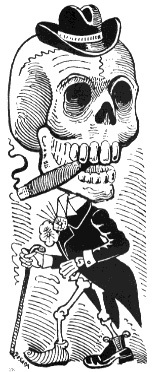
¡Chaucito, chavos! Ciao, kiddies!
 Zócalo Poets