Samuel Selvon: poemas traducidos
Posted: August 31, 2016 Filed under: English, Samuel Selvon, Spanish, ZP Translator: Alexander Best | Tags: Poetas de Trinidad y Tobago Comments Off on Samuel Selvon: poemas traducidos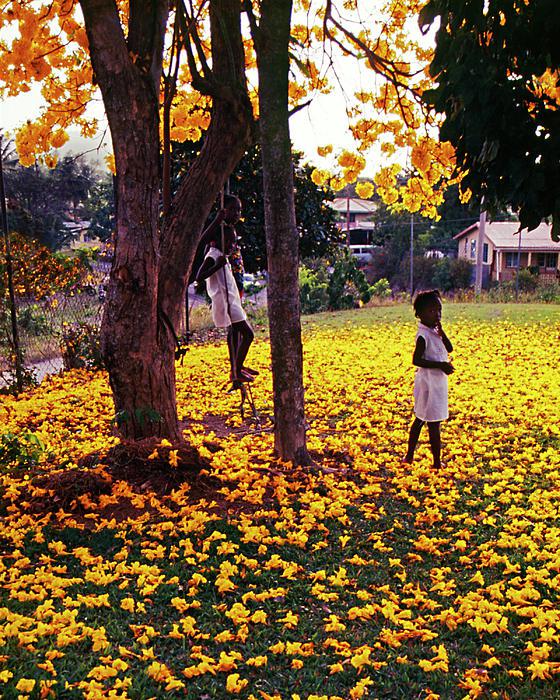
Niños jugando bajo de un guayacán o árbol tabebuia © fotógrafo santalucence Chester Williams__ Children playing beneath a yellow Poui tree_photograph © Saint Lucian photographer Chester Williams
Samuel Selvon
(San Fernando, Trinidad, 1923-1994)
Temor
.
Lo cierto es que
profundamente
me asusto de la vida:
la lucubración solitaria
(el mediodía tiene su
cavilación también.)
He descubierto que la incertidumbre
está trepando, acechante y listo;
estando pendiente del momento expuesto.
.
Soy pecador:
Eso es la verdad.
Y los pecadores son ellos que
saben demasiado o muy poco.
Porque soy pagano,
venerando las cosas inanimadas:
ser un rey durante un día, solo – ¿pues?
.
Temo que
la fe no sea suficiente,
pero esta vida no esté lleno.
Construyo unos dioses vagos pequeñines:
esos dioses vagos
en lo más profundo de la noche,
o del día superficial.
Pero todos ellos se precipitaron.
. . .
Sueño
.
Perdí un sueño esta mañana
cuando me desperté,
y supliqué a la noche
para traerlo de nuevo.
Los tranvías roncos, en vano;
y aquellos que yo conocía
pasaban por un desconocido
separado a sí mismo…
.
En un desconcierto completo
averigüé a un méndigo en el parque
– una voz entusiasta por nada sino una voz –
y el reloj de la iglesia
hablaba alocadamente de
alguna hora de la tarde.
.
Pues entendí
el secreto del círculo cuadrado,
y miré la muerte de la Eternidad;
y dos por dos es igual a cinco.
Yo veía el Tiempo tambaleándose
y una puesta del sol
en el centro del cielo.
.
El méndigo escupió
sobre una hoja seca en el polvo…
El bufón era sordo,
entonces escuchaba
el vacío tremendo que yo contaba…
Pues me desperté.
. . .
Consuelo
.
La reacción inmediata a la acción
no es la cosa auténtica
ni representa el hombre usual.
Una furia caliente a causa de un golpe;
un júbilo rápido después de un beso:
estos pasarán, y luego
llegará la verdad.
.
Y puede que sí – con la vida.
Esta existencia en un dos por tres,
dentro de la eternidad del Tiempo,
puede ser que sea la reacción;
y cuando nos moriremos
llegarán los ámbitos, las reflexiones más sabias:
la lucidez de la vida.
. . .
El árbol guayacán
.
Para conseguir la vista esencial
de este árbol guayacán en el parque,
o sea, mirar las floraciones amarillas
parcheando lo azul del cielo tropica,
tengo que estar parado a cierta distancia.
.
Para agarrar una falta de vida
es pisar las flores tiradas sobre la hierba;
es mirar las últimas de la rama hasta el suelo:
una respuesta reluctante a la gravedad.
.
Únicamente son los niños que
entienden la belleza límpida;
con manos extendidas y ansiosas
tras las flores para bloquear un rato
su caída al suelo.
Parto de ellos
porque soy demasiado viejo para comprenderlo.
. . .
Los cuatro poemas arriba están incluidos al volumen de 2012, The Poems of Sam Selvon, editado por Roydon Salick, con un prólogo de Kenneth Ramchand. La mayoría de la poesía de Samuel Selvon data de los años 40, antes de su emigración al Reino Unido. Durante las dos décadas que siguieron, Sr. Selvon se volvió reconocido por sus obras literárias: novelas, relatos cortos, dramas para la radio BBC, y ensayos. Pero empezó todo con algunos poemas inquisitivos y tiernos, escritos mientras vivía en la ciudad de Port-of-Spain donde trabajaba como corresponsal del periódico Trinidad Guardian.
. . .
Samuel Selvon
(San Fernando, Trinidad, 1923-1994)
Fear
.
To tell truth
I am deeply afraid of life,
The lonely lucubration
(Noon-day has its pensiveness
Too).
I have found uncertainty
Creeping,
Lurking just a little way off,
Waiting, watching for the
Unguarded moment.
.
I am a sinner.
That is the truth of it.
And sinners are those who
Know too much or too little.
For I am a pagan
Worshipping inanimate things:
King for a day, and then?
.
I am afraid
Faith might be insufficient,
Yet life might not be full.
I build little vague gods:
Those vague gods in the deep
Of night
Or of the shallow day.
But they all come tumbling
Down.
. . .
Dream
.
I lost a dream this morning
When I woke
And prayed the night
To bring it back again.
In vain the noisy trams;
And those I knew I passed
A self-estranged stranger…
.
In utter bewilderment
I probed the beggar in the park
(An eager voice for nothing
But a voice)
And the clock on the church
Spoke crazily of some time
In the evening.
.
And then I knew
The secret of the square circle,
And saw Eternity die
And two and two make five.
Saw Time staggering,
And a sunset
In the centre of the sky.
.
The beggar spat
On a brown leaf in the dust…
The fool was deaf
So he listened
To the tremendous nothingness
I spoke…
Then I awoke.
. . .
Consolation
.
The immediate reaction to action
Is not the true thing
Nor depicts the usual man.
Hot fury at a blow;
Swift joy at a kiss,
Will pass, afterwards
The truth will come.
.
So perhaps with life,
This split-second existence
In the eternity of Time
Might be the first reaction,
And when we die, will come
Wiser realms, soberer thoughts ––
The truth of life.
. . .
Poui Tree
.
To get the essential view
Of this particular
Poui tree in the park,
That is to say, to watch
The yellow blossoms patch
The blueness of the tropic sky,
I must stand some distance off.
.
To capture lifelessness
Is to trample on the flowers
Lying on the grass,
To look at the death-throes
From limb to earth,
The reluctant answer
To gravity.
.
Only children know
The pristine beauty,
With eager outstretched hands
After the flowers from the earth
To bar their fall
A little longer.
I leave them because
I am too old to understand.
. . .
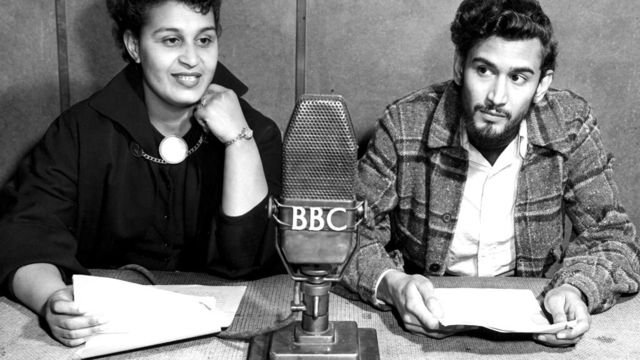
Pauline Enriques with Samuel Sevlon_Caribbean Voices BBC radio programme_1952
The above poems are included in the 2012 volume The Poems of Sam Selvon, edited by Roydon Salick, with a foreward by Kenneth Ramchand, and published by Cane Arrow Press.
The four poems here date from 1947. The bulk of Samuel Selvon’s poetic output dates from before 1950 (the year he emigrated to London, England), though his long prose-poem, “Poem in London” (which was broadcast on BBC Radio’s Caribbean Voices programme in 1951) is perhaps the most famous. Best known for his novels, short stories, radio dramas and non-fiction writing, Selvon’s poems had too long lain in vintage magazines and archive drawers until Cane Arrow Press decided to present these romantic, philosophical verses to the reading public.
. . . . .
Anson Gonzalez: poemas traducidos
Posted: August 31, 2016 Filed under: English, Spanish, ZP Translator: Alexander Best | Tags: Poetas de Trinidad y Tobago Comments Off on Anson Gonzalez: poemas traducidos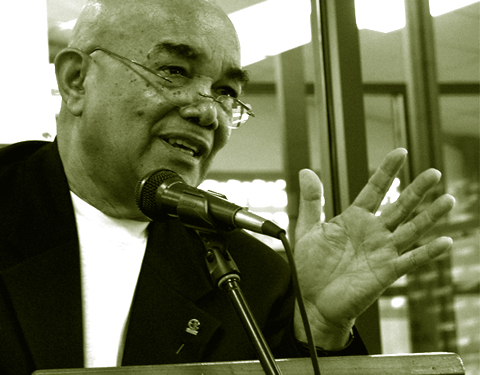
Anson Gonzalez
(Catalizador y motivador de la literatura caribeña / Poeta)
Poemas en prosa:
del poemario Cruce de Sueño (Crossroads of Dream) (2003)
.
La misma dirección durante cuatro décadas – ¿estabilidad o inercia?
Un solo empleo desde la edad de dieciséis – ¿virtud o fracaso?
Nunca había residido or estudiado en el extranjero – ¿restringido o contento?
Su cacharro y él – juntos para veinticinco años.
La misma esposa, los mismos hijos para cuarenta años
– ¿un compromiso de larga duración o un terror de cambio?
¿Puede ir al próximo nivel, o siempre estará fijado a éste
pues lo encantará eternamente?
El mismo corazón – latiendo desde su nacimiento.
. . .
La araña Anansi se escabullía sobre el cielo de la habitación – como un ninja.
Silenciosamente se centró para capturar una panzada. Mientras concentrándose
en su comida no se dio cuenta de la lanza que se preparaba para arponearle.
Él escuchó la oración halal; sintió las mantras kosher; las bendiciones baraka bashad.
Mientras tanto, el gigante estuvo listo para enviarle hasta su próxima encarnación.
No puedo viajar con la barriga hambrienta, pensó, y de repente dejó descender a sí mismo
una distancia escarpada, y aterrizó el piso cerámico. Corriendo en piernas tambaleantes,
él pasó zumbando hacia la oscuridad, desesperado por esquivar. Apresurándose, corriendo
a las zonas oscuras – demasiado rápido por la araña – un guerrero sobrecargado de vejez.
Se escapó en un recoveco, aterrado pero vivo, y seguro hasta la próxima tentativa de comer.
. . .
Erupciona la hermosura antes del comienzo del tiempo de la cosecha
y los retoños proclamando su plenitud. Borlas cónicas deslumbran el
paisaje navideño de cañas de azúcar. Ellas brillan como los fuegos
artificiales del Año Nuevo que saludan las mañanas de enero – fuegos que
se cortan el chorro – aleatoriamente – después de una expresión efímera pero
gloriosa, de deleite.
Pues, comienza el esfuerzo amargo, y la belleza se inclina por las cuchilladas
de brazos golpeandos que le arrazan a ella en la causa de supervivencia.
Carretillas y remolques rodan, las ruedas de las fábricas gruñen, y el calor
convierte en la riqueza la realidad. El hollín se difunde y cubre el lugar de belleza
con la pátina del Hades. Del sitio de cremación, cercano, el humo oscurece el cielo.
. . .
Mientras sale a caminar al kiosco de diarios, la blancura de platino
del sol baña el valle con las bendiciones. Los vecinos del hombre,
sus cuatro rosas rojas se balancean con un resplendor al aire – como
unos besos del bel alba. La neblina de las colinas se desvanecía
como el aliento del dulce amante al momento de separación.
De pronto, el día parecía tan bendecido y espléndido:
Fue posible, casi posible, olvidar la amenaza a la seguridad de una
confrontación entre el Gobierno y unos insurgentes aspirantes que
habían amenazado nuestra urbanidad y seguridad una vez antes.
Fue un momento yuxtapuesto entre el sagrado y el vulgar. Él estuvo balanceando
en el humbral de una emoción inexplicable, y reflexionó sobre un querido
amigo. Cuando regresó, su esposa estuvo regando sus flores amadas para
salvaguardarlas de las atenciones abrasadoras del ojo antillano al cielo.
. . .
Anson Gonzalez
(Catalyst and motivator for Caribbean literature /
Poet / born Trinidad & Tobago)
Prose poems from Crossroads of Dream (2003)
.
Same address for four decades – stability or inertia? One job
since sixteen – virtue or failure? Never lived or studied abroad
– limited or contented? His old car and he – together for
twenty-five years. Same wife and children for forty years –
longterm commitment or fear of change? Can he go into the next
plane – or will he be attached forever to this one and haunt it
eternally? Same heart beating beating from birth.
. . .
Anansi slinked on the ceiling like a ninja. He quietly settled
in to capture a bellyful. Concentratin on his meal, he didn’t
notice the pole preparing to spear him. He heard the halal
prayer. He sensed the kosher incantations, the baraka bashad
blessings, as the giant prepared to send him to his next
incarnation. Can’t travel on hungry belly, he thought, dropping
suddenly the precipitous distance, hitting the tiled floor,
running on kilkitay legs, scurrying to the darkness, desperate
to escape. Scurrying, hurrying into the darkened areas, too fast
for the age-encumbered warrior, to escape in a crevice, terrified
but alive; safe till another attempt at feeding.
. . .
Beauty erupts before croptime starts and ratoons announce
their time of fullness. Conical tassels dazzle the Xmas canescape.
They shimmer like New Year’s fireworks on January mornings
that go out desultorily after their short-lived but glorious
expressions of delight. Then, bitter toil begins; beauty bows to
the slash of striking arms that lay her low in the cause of survival.
Carts and trailers trundle, factory wheels grumble; heat converts
reality to wealth. Soot spreads and covers beauty’s place with a
patina of Hades. From the nearby cremation site smoke darkens the sky.
. . .
As he stepped out to go to the newsstand, the platinum
whiteness of the sun bathed the valley with its blessings. His
neighbour’s four red roses swayed resplendently in the air like
beautiful dawn kisses. Mist on the hillsides was dissipating
like a sweet lover’s breath at the moment of parting. Day
suddenly seemed so blessed and glorious that one could almost
forget the security threat in a confrontation between Government
and some would-be insurrectionists, who had threatened our
civility and safety once before. It was a moment juxtaposed
between sacred and profane. As he balanced on the cusp of an
inexplicable emotion, he though of his dear friend. When he
returned, his spouse was watering her beloved flowers to save
them from the scorching attentions of the Antillean eye in the sky.
. . .
Anson Gonzalez no empezó a escribir sus propios poemas hasta 1984, aunque había encabezado un movimiento literario en su nación nativa – Trinidad y Tobago. Fundó la revista pancaribeña New Voices (Nuevas Voces) durante los años 70, y lanzó el evento anual Poetry Day (Día de la Poesía) en octubre de 1979. Fue coadyutorio también en la creación de la Writers’ Union of Trinidad y Tobago (Unión de Escritores de Trinidad y Tobago).
. . .
Anson Gonzalez began writing poetry in 1984, though he had been involved in the arts – as founder and editor of The New Voices bi-annual journal during the 1970s. He was an important motivator and promoter of literary culture in the Caribbean – and in Trinidad & Tobago most especially. Poetry Day, observed every October, was an event launched by Mr. Gonzalez in 1979, and he also helped to form the Writers’ Union of Trinidad and Tobago. Survived by his wife Sylvia, T&T’s Poet Laureate died in 2015, in Cardiff, Wales, where his adult daughters have made their home.
. . . . .
Jennifer Rahim: poemas traducidos
Posted: August 31, 2016 Filed under: English, Jennifer Rahim, Spanish, ZP Translator: Alexander Best | Tags: Poetas de Trinidad y Tobago Comments Off on Jennifer Rahim: poemas traducidos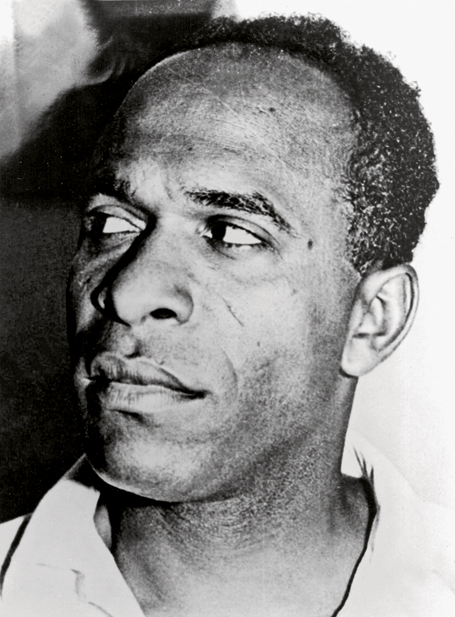
Frantz Fanon (1925- 1961): escritor y revolucionario nacido en Martinica_autor de “Los condenados de la tierra” / French- Caribbean writer and revolutionary from Martinique_most famous for his book “The Wretched of the Earth”
Jennifer Rahim
(Trinidad y Tobago)
Versos para Fanon: 1
.
Insististe en que hablabas para tu era.
Bien, Fanon – ahora es.
Como albañiles ingenuos,
construimos sobre la arena de jeraquías falsas,
prejuicios de todo tipo y mezclados con argamasa;
erigimos paredes por dividirnos, no alojarnos
– desconocidos, el uno al otro.
Escucha – el mundo está ruidoso con
el infierno de su propia construcción:
naciones que clonan con la guerra la democracia;
religiones que sacrifican al dogma la fe;
y la inocencia asesinada sobre el altar
de pasiones hórridas.
¡El tiempo de carroña, compañero!
No hay gente aquí sino una comitiva triste de fantasmas
apiñandose juntos. Las puertas están atrancadas y
la gente permanece seca de la tormenta de
nuestro fracaso colosal:
no amaremos más completos que cualquier credo venerado o odiado.
Reza, santo imperfecto, que saltaremos la cancela
– por fin.
. . .
Versos para Fanon: 2
.
El mundo no es como habías deseado, compañero.
Quizás nunca habías anticipado su llegada,
pero trabajabas la esperanza a un lenguaje
grande como la metáfora. La esperanza es
la única fe que puede trasladar una visión
sobre las líneas fortalecidas que nos ciñen
en parcelas que son demasiadas pequeñas
para el universo que fluye, sin costura, por tu sangre.
No es como lo habías imaginado, el mundo.
Exististe demasiado temprano, y nosotros – demasiado tarde.
Entonces somos una humanidad que arrastra sus pies,
y estamos destinados a lamentar el reino casi posible.
No, no somos las estrellas que soñabas tocar
– unos puros resplandores liberados de
cualquier pasado que bloquea la visión –
niños dispuestos y ávidos
– por fin.
. . .
Nota a mí misma
.
Un padre también merece la norma de siete-por-setenta.
(Nota a mí misma: no es un poema.)
Ninguna cosa que yo he dicho sobre ti era cierto. Nada que dije
alguna vez visitó tu sufrimiento fruncido
– algo que solamente yo ideara. Mi padre, vivía
el veredicto de mi deseo que seas un héroe, durante esos días
cuando se caían los dioses; yo quería que seas un dios
viniendo para rescatarme. Ay no, los padres no deben ser escritos
a menos que les permitamos ser en carne y hueso
– necesitando clemencia.
Solo es ahora, cuando resplandece tu vida en su fin,
que empiezo a entenderte.
. . .
Jennifer Rahim
(Trinidad and Tobago)
Lines to Fanon I
.
You insisted you spoke for your time.
Well, it is now, Fanon. Like foolish masons,
we build on the sand of false hierarchies,
prejudices of all kinds mixed with mortar,
walls erected to divide, not house us all –
strangers to each other.
Listen, the earth is noisy with the hell
of its construction: nations clone democracy
with war, religions sacrifice faith to dogma,
innocence murdered on the altar
of horrid passions.
Carrion time, brother!
No people here, just a sad company of ghosts
huddled together, doors bolted, keeping dry
from the storm of our colossal failure
to love larger than any creed
we venerate or hate.
Pray, imperfect saint,
we finally leap the gate.
. . .
Lines to Fanon II
.
The world is not as you desired, brother.
Maybe you never expected its arrival,
but worked hope into a language large
as metaphor – the one faith that transports
vision across hardened lines that gird us
in plots much too small for the universe
coursing, seamless, through your blood.
The world is not as you imagined it.
You were too soon, and we too late.
So we are a drag-foot humanity, destined
to lament the kingdom almost possible.
No, we are not the stars you dreamed
to touch, pure radiances unfettered
by any past – barring vision –
like bright-eyed children, at last.
. . .
Note to Self
.
Fathers, too, deserve the seven times seventy rule. (Note to self: not
a poem.) Nothing I ever said of you was true. Nothing said visited
your pursed suffering I could only imagine. Father, you lived the
sentence of my wanting you to be a hero, in those days when gods fell.
I wanted you to be a god to my rescue. No, fathers should never be
written unless we allow them, first, to be flesh, needing forgiveness.
Only now, when your life glows at its end, I begin to see you.
. . .
Poeta, ensayista y escritora de cuentos, Jennifer Rahim es una profesora también de la Universidad del Caribe (UWI) en Saint Augustine, Trinidad y Tobago. Fue una galardonada del premio Casa de las Américas en 2010 con su poemario Approaching Sabbaths (Sabbates inminentes ). Los poemas arriba están incluidos en el volumen Ground Level (Al nivel del suelo): (Peepal Tree Press, 2014).
. . .
Trinidadian poet/essayist/short-story writer Jennifer Rahim is a Senior Lecturer at the University of the West Indies in St. Augustine, Trinidad and Tobago. She was awarded a Casa de las Américas prize in 2010 for her collection Approaching Sabbaths. The above poems are from her 2014 Peepal Tree Press volume Ground Level.
. . . . .
Lorna Goodison: “Días del Bibliobús” (Bookmobile Days)
Posted: August 14, 2016 Filed under: English, Lorna Goodison, Spanish, ZP Translator: Alexander Best Comments Off on Lorna Goodison: “Días del Bibliobús” (Bookmobile Days)
Lorna Goodison (born 1947, Kingston, Jamaica)
Bookmobile Days
.
Reader 1
.
The one who was pressed
up against the door
clutching the last book borrowed;
book read by naked light bulb,
street lamp, bottle torch, or moonlight.
.
The child who’d cut ties
to blood lines and school friends
in order to make the acquaintance
of characters bound to become
trusted lifelong companions.
.
That one would brave blizzards,
extract swords from stones,
fly back to Guinea never ever
having eaten salt.
Fall in and out of doomed love,
forget tethered goats,
neglect to fetch water
in a tin that once brought kerosene
and so draw the ire of parents.
This is the one who would
climb aboard wide-eyed and greedy
for what was carried in the hold
of our brave new world caravel on wheels.
.
Reader II
.
She said: “I’d like a book of fairy tales, please.”
It was a weekday
but she was all Sunday clothes.
Pink frilly frock butterfly bows
white socks patent leather shoes.
She said her godmother had dressed her up
to come and visit the bookmobile.
. . .
Lorna Goodison (nace 1947, Kingston, Jamaica)
Días del Bibliobús
.
Lectora 1
.
Ella que presionó sobre la puerta,
agarrando el último libro prestado
– un libro leído por
una bombilla pelona / una farola / una linterna en botella /
la luz de luna.
.
La criatura que rompió la relación con
su linaje y camaradas de escuela
para conocer a
personajes destinados a volverse
compañeros leales de toda la vida.
.
Ella que desafiaba nevascas;
extraía espadas de las rocas;
volaba de vuelta de Guinea
jamás de los jamases
habiendo comido la sal.
Enamorarse de alguien / desencantarse del mismo
a causa del amor malhadado;
olvidar cuidar a las cabras atadas;
no cumplir con traer el agua en una lata
que contenía el queresén
– y de esa manera enfurecer a los padres.
Ésta es ella que se montara a la ‘carabela-sobre-ruedas’,
la carabela de nuestro ‘mundo feliz’;
ésta es ella: ingenua y ávida por
lo que llevaban en la bodega del ‘barco’.
.
Lectora 2
.
Ella dijo:
“Me gustaría un libro de cuentos de hadas – por favor.”
Durante un día de semana…pero
ella llevaba puesta su ropa de domingo:
un vestido de color rosa con volantes y lazos en forma de mariposa;
calcetines blancos con zapatos de charol.
La muchachita dijo que su madrina
había vestir elegante a ella – para venir a visitar el bibliobús.
. . .
Image at top: Cover of Gitanjali by Rabindranath Tagore. This book is the subject of a companion poem to “Bookmobile Days” called “Tagore on the Bookmobile”.
Lorna Goodison lives in Ann Arbor, Michigan, where she teaches at the University of Michigan. She also divides her time between her native Jamaica and Toronto, Ontario, Canada – just “up the road” from Michigan. The poem featured here is from her most recent poetry collection, Supplying Salt and Light, published by McClelland & Stewart in 2013; Goodison did the watercolour painting on the cover. Her first book of poems, Tamarind Season, from 1980, also included illustrations by her own hand. In 2013 Goodison was awarded Jamaica’s Order of Distinction for “outstanding achievements in Literature and Poetry.”
. . .
Un otro poema de Lorna Goodison / Another poem by Lorna Goodison: “Mi Testamento” / “My Will”
https://zocalopoets.com/category/poets-poetas/lorna-goodison/
. . . . .
KULTURA Filipino Arts Festival, August 5th to 7th, in Toronto!
Posted: August 5, 2016 Filed under: Bienvenido C. Gonzalez, Edwin A. Lozada, Eileen R. Tabios, English, H. Francisco V. Peñones, Ilocano, Jon Pineda, Patrick Rosal, Rhodora V. Peñaranda, Spanish, Tagalog / Filipino, Victor P. Gendrano Comments Off on KULTURA Filipino Arts Festival, August 5th to 7th, in Toronto!
. . .
2016 marks the 11th year for Kultura, which emerged from the youth-led Kapisanan Phillippine Centre for Arts & Culture – a small yet ambitious initiative based out of a store-front on Augusta Avenue in Toronto’s Kensington Market neighbourhood.
The Kultura festival now celebrates the vibrant, contemporary creative expression of Filipino-Canadians. This is an important event for dialogue within the community, as well as for sharing a deeper understanding of Filipino culture and experience with the broader communities of Toronto – beyond the limiting clichés of “cultural costumes and food”. Kultura features multiple art disciplines, including culinary and fashion. Kultura aims to discuss the Filipino diaspora in Canada and to elevate Filipino-Canadian culture from the perception that it is flat and static to one that is multi-dimensional and active.
.
Kultura is the brainchild of the Kapisanan Centre, a charitable community organization with strong youth leadership. Kapisanan has created a safe space for Filipino-Canadian youth, both second generation and newcomers, to overcome multiple barriers that keep them from meaningful engagement in society. To explore identity, to foster pride and self-confidence – that’s Kapisanan!
. . .
Some contemporary Filipino-in-diaspora poetry…
Victor P. Gendrano (California)
Japanese Haiku
. . .
ospital silid hintayan
ang plastik na mga bulaklak
palaging bukad
.
waiting room
the plastic flowers
always in bloom
. . .
pinagbiling bahay
puno ng halakhak
ng maga bata
.
sold house
children’s laughter echoes
from its bare walls
.
(2005)
. . .
Japanese Tanka
. . .
chopping onions
enough excuse
to shed my tears
as I cook for myself
this New Year’s eve
.
di lang sibuyas
sanhi ng pagluha
kundi sa pangungulila
pagluluto sa sarili
ngayong bagong taon
. . .
scent of jasmine wafts
through her open door
this sultry evening
she calls him to say
don’t be late coming
.
the torn jacket
and worn-out cane
lie near a trash bin
his chuckle still echoes
from the empty bed
.
(2007)
. . .
Aloneness (a Korean Sijo)
.
the visiting son laments
his loss of their backyard tree
.
where as a teen he carved a heart
to express his very first love
.
his widower dad explains
twice there I tried to hang myself
. . .
Alheizmer Disease
.
as I brush mom’s golden hair
she keeps talking to unseen friends
.
she accepts me now as a friend
in the hospice where she lives
.
sometimes I wonder if she knows
I am her least-liked daughter
.
(2007)
. . .
Victor P. Gendrano is a retired librarian from the Los Angeles County Public Library. He completed his Bsc in the Phillippines and his Msc at Syracuse University in New York state. From 1987 to 1999 he edited Heritage Magazine, an English-language quarterly. His website, Haiku and Tanka Harvest, focuses on his poetry in a variety of structured forms and styles, as well as free verse in English and Tagalog. Mr. Gendrano is the author of Rustle of Bamboo Leaves: selected haiku and other poems, published in 2005.
. . .
H. Francisco V. Peñones, Jr.
Homage to Frida
(On the Centennial of her Birth)
.
Kahlo: kaluluwa: (n). Tagalog for soul ––
O Soul of my bleeding heart pigeon-
holed in tin retablos hung in antiseptic wards
unwind your bandaged flesh and let me in
your body its plains of crumbling rocks
and howling dust is no strange country
to me. Buko kanakong estranyo ‘di.
Back home, the land cracks and opens wide
throwing up the bodies dumped at night.
Its womb refusing now any stirring of seedling
despite so much marrows in its furrows.
O Nuestra Señora de Dolores y Tristezas*
wrap me in your leafy arms as you did
Diego Rivera or yourself in infants’ bodies
yet with your lusting faces in a kind of pietà,
in a loving moment caged in the canvas.
Arog ka kanakong banwaan, (like my country)
Natusok naman ako. (I am pierced too.)
Pero en sus autoretratos por ejemplo**,
.
I am not pricked by the thorns of the cactus
which thrusts up like a pen against the sky
and my brows are as high and thick and black
as your brushes and your gaze –– a doll’s,
set in place and silent in a corner yet forever.
. . .
*Our Lady of Sorrows and Sadness
**But in her self-portraits, for example
. . .
Self Portents from a Crystal Ball
.
Between the onyx equinox
and the Martian meridian
your Saturn son is on the ascendant
towards the power clique.
Rorschach stains
whirl nebulous as violet capes
worn in Salamanca:
Beware of men in ties,
they shake your hands while
coming out straight from the john.
Swirling lights tie up
the head and the tail, a circular
tale and mandala of survival and decency
you may well just be
heading for St. Francis Alley.
.
Acid rain dust leaks out
slimy green in brain drain canals:
invest in futures, better still
the dioroxine fuel yet to be found
and named.
.
Some silicone spilled semen
unearth Buddy Holly, a boozed
night out in Malate
and the apparition in the 7th Virgo
of one claiming paternity.
Raspy grains the pores of skin
up close your nose oooom
a hint of civet in heat:
go pick a lady in the primary
though you keep a red card
in your wallet for lemme see…
. . .
H. Francisco V. Peñones, Jr., has studied in the MFA Creative Writing program at San Jose State University, and is acknowledged as a pioneer in the renaissance of writing literature in the Bikol language of his native Phillippines. Peñones’ first poetry collection, entitled Ragang Rinaranga (Belovéd Land) was published in 2006.
. . .
Rhodora V. Peñaranda
Great Expectation
.
The light goes off in this town of rationed power.
Brief dark shadows up and down the road.
.
A village dog picks up her scent and begins to bark.
Out of the sky, a flood of darkness with invisible beasts
.
bounding over the street and wedging into the heart.
She comes home, and out of the steaming dark,
.
her little brother, the boy like a cat waiting all night
purring for a rubbing on his back, leaps to his feet,
.
begging her to stay. She flicks her fan to spread the coolness,
and he gropes for the arts of her comfort, the tucking
.
into the soft bed, rocking him to the wind’s mothering.
But she is hurrying. She does not feel the present under her feet.
.
She does not know the future. She does not have the past.
She passes through the rooms and gathers only tedium’s grief,
.
the unwashed growth of things crowded with details, details
accelerating with the pressure of wars around her, so she leaves
.
in the veiled cold of the room,
the soft gestures curled inside the glass of a burning lamp.
Leaves him instead the words that order him
.
to face it like a man leaving him alone on a night like this
where only the dead walk, to conjure the man he has yet to be.
.
(2007)
. . .
Rhodora V. Peñaranda lives in New York state. Two of her published volumes of poetry include Touchstone (2007) and Unmasking Medusa (2008).
. . .
Edwin A. Lozada
Kansion
(in the Ilocano language)
.
Agtaytayab
Purao
Nga kalapati
Ti rimwar
Diay nabanglo
Nga sabong
Purao ken kiaw
Kiay nakaturog
Nga kalachuchi
.
Agtaytayab
Purao
Nga kalapati
Diay puso na
Agliplipias
Ti kansion
Kolor ti rosas
Ken gumamela
Nga awan pay
Ti nakangeg
.
Papanam ngay
Billit
Nga naulimek,
Sika
Ti makapagtalna
Diay langit?
Sinno ngay
Ti makangeg
Dagita regalo
Nga rumrumwar
Diay pusum?
.
Nakadanon
Idiay karayan
Ket inungwanna
Idi kuan nagpukawen
.
Didiay karayan
Agkankanta
Napunpunno ti sampaga
Rosal, rosas
Ken gumamela
. . .
Canción
.
volando va
la paloma
blanca
que salió
de la flor
perfumada
alba y ámbar
de la plumeria
adormecida
.
va volando
la paloma
blanca
su corazón desbordado
derrama
canciones
color de rosas
e hibisco
que todavía no
se han oído
.
¿adónde vas
ave callada
y mansa
tú
que apaciguas
el cielo?
¿quién sino tú
oye
los obsequios
brotando
de tu corazón?
.
a la faz del río
llegó y se acercó
dejándole un beso
y entonces desapareció
.
el río
cantando
colmado de sampaguitas
gardenias, rosas
e hibiscos
. . .
Song
.
in the midst
of flight
a white dove
emerged
from the perfumed
amber and ivory
blossom
of the plumeria
lost in slumber
.
watch it fly
as white as the clouds
the dove
with a heart
overflowing
with song
colour of roses
and hibiscus
none yet
has heard
.
where do you go
bird
so quiet and meek
you who can
appease
the heavens?
who but you
can hear
the gifts
coming forth
from your heart?
.
towards the river
the dove drew near
kissed its water and then
disappeared
.
the river
singing and flowing
with gardenias
jazmine, roses
and hibiscus
. . .
Edwin A. Lozada is a poet and translator. He also edited the volume Field of Mirrors: an Anthology of Philippine American Writers, published in 2008 by Philippine American Writers & Artists, Inc.
. . .
Patrick Rosal / Aracelis Girmay
Lamento del Gallo
.
querida gallina caída
cuéntame la historia de una semilla
que contenía
todo el universo en una espina
que picó el ojo
de la noche
me das sed y seda
.
y no te vas
y no te vas
.
y si me enseñas
la ventana de tu boca
te sequiré
por las multitudes de mentirosos
que dicen
no iré
no iré
.
ay gallina
dime algo de tu vestida tan amable
y como robaste la voz de otra ave
.
animal tú eres
animal tú eres
tan bravona
.
se cree que las estrellas fueron hechas
por una sola clave
.
y me haces buscar
por las ruinas del corazón
robándolas de los dientes de esa tierra
.
y aún escucho las susurraciones p’arriba
y no te vas en seguida
.
y no te vas
no te vas
.
querida gallina caída
sueñas sin ignorar el frío
ni el agua ni cuchillo
los lobos aúllan los versos más secretos
no hay nombre que niegue ese sonido completo
.
rompe los cristales con tus lamentos
las torres de arena y de cemento
.
manda a los gobernadores que bajen
entre las alas y tu penúltimo viento
te prometen una bala o una canción
te las prometen
te prometen
.
y no te vas
. . .
Rooster’s Lament
by Aracelis Girmay and Patrick Rosal
(English translation)
.
beloved fallen hen
tell me the story of a seed
that held
the whole universe in a thorn
that pricked the eye
of evening
.
you give me thirst and silk
.
and you don’t go
and you don’t go
.
and if you show me
the window of your mouth
i’ll follow you
through the multitudes of liars
that say
i won’t go
i won’t go
.
oh hen
tell me something about your delightful costume
and how you robbed the voice of another bird
.
animal you are
animal you are
so brave
.
it’s believed that the stars were made
by a single key
.
and you make me search
through the ruins of the heart
robbing them of the teeth of that land
.
and still i listen to the whispers above
and you don’t go
.
lovely fallen hen
you dream without ignoring the cold
nor the water nor the knife
.
the wolves howl their most secret verses
there is no name that denies that complete sound
.
smash the mirrors with your laments
the towers of sand and of cement
order the governors to descend
among the wings and your penultimate wind
they promise you a bullet or a song
they promise them to you
they promise
.
and you don’t go
. . .
Patrick Rosal has authored My American Kundiman, and Uprock Headspin Scramble and Dive, which won the Global Filipino Literary Award and the Asian American Writers’ Workshop Members’ Choice Award – respectively.
.
Aracelis Girmay is of Eritrean, Puerto Rican, and African-American descent. A writer of poetry, essays, and fiction, she earned an MFA from New York University.
. . .
Eileen R. Tabios
Die We Do
.
Die
we do
as much as
.
we live. Then
we write: right
.
what
we lived
when we write.
. . .
Morir Hacemos
.
Morir,
lo hacemos
tanto como vivir.
.
Entonces,
nosotros escribimos:
corregimos aquello que
.
vivimos
cuando, así,
nosotros lo escribimos.
. . .
Tabios’ poem originally appeared in The Light Sang As It Left Your Eyes (Marsh Hawk Press, 2007).
Translation into Spanish / Traducción del inglés al español:
Rebeka Lembo
. . .
Jon Pineda
Matamis
.
One summer in Pensacola,
I held an orange this way,
flesh hiding beneath
the texture of the rind,
then slipped my thumbs
into its core & folded it
open, like a book.
.
When I held out the halves,
the juice seemed to trace
the veins in my arms
as it dripped down to my elbows
& darkened spots of sand.
We were sitting on the beach then,
the sun, spheres of light within each piece.
I remember thinking, in Tagalog,
the word matamis is sweet in English,
though I did not say it for fear
of mispronouncing the language.
.
Instead, I finished the fruit & offered
nothing except my silence, & my father,
who pried apart another piece, breaking
the globe in two, offered me half.
Meaning everything.
. . .
Birthmark
.
After they make love, he slides down so his face rests near her waist.
The light by the bed casts its nets that turn into shadows. They both
fall asleep. When he wakes, he finds a small patch of birthmarks on
her thigh, runs his finger over each island, a spec of light brown
bundled with others to form an archipelago on her skin. For him, whose
father is from the Philippines, it is the place he has never been, filled
with hillsides of rice & fish, different dialects, a family he wants to
touch, though something about it all is untouchable, like love,
balanced between desire & longing, the way he reaches for her now, his
hand pressed near this place that seems so foreign, so much a part of
him that for a moment, he cannot help it, he feels whole.
. . .
The two poems above are from Jon Pineda’s 2004 collection Birthmark, winner of the Crab Orchard Award Series in Poetry.
. . .
Bienvenido C. Gonzalez
I Quit
.
BEAT A BAD
……………..HABIT
BY REDUCING
………………A BIT
DAILY EVERY
…………………BIT
TILL YOU RID OF
…………………..IT
. . .
PERSEVERANCE
.
IF AT FIRST YOU DON’T
SUCEEDE
SUCCEDE
SUCCEED
TRY, TRY AGAIN.
. . .
Bienvenido C. Gonzalez is a wordsmith!
He creates neo-words and logos as a hobby.
The poems above are from his PARA-PRAISES
– tributes to old and original sayings.
. . . . .
All the poems selected here are contained in the 2008 anthology Field of Mirrors, edited by Edwin A. Lozada, © Philippine American Writers & Artists, Inc.
. . . . .
John Ashbery: “Paradojas y Oxímorones”: un poema del inglés
Posted: July 30, 2016 Filed under: English, John Ashbery, Spanish, ZP Translator: Alexander Best Comments Off on John Ashbery: “Paradojas y Oxímorones”: un poema del inglés
John Ashbery (born 1927, Rochester, New York, U.S.A.)
Paradoxes and Oxymorons
.
This poem is concerned with language on a very plain level.
Look at it talking to you. You look out a window
Or pretend to fidget. You have it but you don’t have it.
You miss it, it misses you. You miss each other.
.
The poem is sad because it wants to be yours, and cannot.
What’s a plain level? It is that and other things,
Bringing a system of them into play. Play?
Well, actually, yes, but I consider play to be
.
A deeper outside thing, a dreamed role-pattern,
As in the division of grace these long August days
Without proof. Open-ended. And before you know
It gets lost in the steam and chatter of typewriters.
.
It has been played once more. I think you exist only
To tease me into doing it, on your level, and then you aren’t there
Or have adopted a different attitude. And the poem
Has set me softly down beside you. The poem is you.
.
(1981)
.
. . .
John Ashbery (nace 1927, Rochester, Nueva York, EE.UU.)
Paradojas y Oxímorones
.
Este poema trata del lenguaje – sobre un nivel muy puro.
Mira como este poema está platicando contigo.
Contemplas, desde una ventana,
O finges andar como pepita en comal.
Lo posees pues no lo tienes; lo faltas y ello te extraña;
Ustedes se extrañan – uno al otro.
.
Este poema está melancólico porque desea ser tuyo pero no puede.
¿Qué es, un nivel puro? Es eso – y otras cosas –
Poniendo en práctica – entrando en juego – un sistema de todo.
¿Entrando en juego? En hecho, sí.
Pero considero que el juego existir como
.
Una cosa más profunda y externa, como un patrón soñado de papeles,
Como hay en la división de la Gracia
Durante los días de la canícula en agosto
– sin prueba. Con final abierto. Y, antes de darte cuenta,
Ello se pierde en el vapor y en la cháchara de las máquinas de escribir.
.
Ha estado tocado, una vez más. Creo que vivas para
Provocarme hacerlo, en tu nivel; pues no estás allí
O has asumido una actitud distinta. Y el poema
Ha dejarme – tiernamente – al lado de ti.
El poema
Es tú.
. . . . .
Elizabeth Bishop: “Un Arte” / “One Art”
Posted: July 29, 2016 Filed under: Elizabeth Bishop, English, Spanish, ZP Translator: Alexander Best Comments Off on Elizabeth Bishop: “Un Arte” / “One Art”

 Zócalo Poets