“In Flanders Fields”: the Remembrance Day poem – in five languages
Posted: November 11, 2015 Filed under: Arabic, English, French, German, John McCrae, Spanish | Tags: Poemas para el Día del Recuerdo Comments Off on “In Flanders Fields”: the Remembrance Day poem – in five languages
“In Flanders Fields”: the Remembrance Day poem – in five languages…
In French:
John McCrae (1872-1918)
Dans les champs de Flandres
.
Dans les champs de Flandres les coquelicots sont en fleurs
entre les croix, rang par rang
ça marque notre place, et dans le ciel
les alouettes, chantent toujours bravement, volent
rarement entendues par les fusils en bas.
Nous sommes les Morts. Il y a peu de temps,
nous vivions, sentions le crépuscule, regardions le soleil couchant,
aimions, et étions aimés, et maintenant nous sommes allongés
dans les champs de Flandres.
Admets notre dispute aven l’ennemi;
pour toi de nos mains blessées, nous jetons
le flambeau à ton tour de relever
si tu n’as pas confiance en nous qui sommes morts
nous ne dormirons plus, bien que les coquelicots poussant
dans les champs de Flandres.
. . .
In Spanish:
John McCrae
(poeta-médico-soldado canadiense,
nacido en Guelph, Ontario, Canadá, 1872 – falleció 1918, en Francia)
En los campos de Flandes
.
Se mueven las amapolas
entre las filas de cruces,
que señalan nuestro sitio;
y en el cielo las alondras,
cantan desafiantes pese a todo,
vuelan oyendo apenas los cañones de abajo.
Somos los Muertos.
Hace pocos días vivíamos,
sentíamos el amanecer,
veíamos el brillo del crepúsculo,
amábamos y éramos amados,
y ahora yacemos en los campos de Flandes.
.
Haz tuya nuestra lucha contra el enemigo:
a ti pasamos la antorcha desde nuestras desfallecidas manos;
hazla tuya para mantenerla en alto.
Si faltas a la palabra que diste a los que morimos
no dormiremos, aunque crezcan las amapolas
en los campos de Flandes.
. . .
“In Flanders Fields” es un poema de guerra en forma de rondó escrito durante la Primera Guerra Mundial por John McCrae perteneciente al Cuerpo Expedicionario Canadiense desplegado en Flandes. McCrae quedó muy afectado por la muerte de su amigo (y antiguo alumno) teniente Alexis Helmer durante la Segunda Batalla de Ypres. Al día siguiente, 3 de mayo de 1915, McCrae, inspirado por la muerte de Helmer junto con tantos otros soldados y observando la cantidad de amapolas que crecían entre las cruces de los caídos, escribió “In Flanders Fields”. El poema fue publicado sin firmar y por primera vez en la revista londinense Punch del 8 de diciembre de 1915.
. . .
John McCrae
In Flanders Fields (composed in May of 1915 — this is the original poem)
.
In Flanders fields the poppies blow
Between the crosses, row on row,
That mark our place; and in the sky
The larks, still bravely singing, fly
Scarce heard amid the guns below.
.
We are the Dead. Short days ago
We lived, felt dawn, saw sunset glow,
Loved and were loved, and now we lie
In Flanders fields.
.
Take up our quarrel with the foe:
To you from failing hands we throw
The torch; be yours to hold it high.
If ye break faith with us who die
We shall not sleep, though poppies grow
In Flanders fields.
. . .
In Arabic:
In Flanders fields the poppies blow
في حقول الفلاندرز يزهر الخشخاش
Between the crosses, row on row,
بين الصًّلبان المرصوفة صفّـاً صـفّاً،
That mark our place; and in the sky
ذاك هو علامة مكاننا؛ وفي السَّماء
The larks, still bravely singing, fly
ما تزال القبّرات، مترنِّمة دون وجل، تطير
Scarce heard amid the guns below.
لا تكادُ تُسمَعُ وسط أصوات البنادق تحت !
We are the Dead. Short days ago
نحن الأمواتُ. وقبل أيامٍ قلائـلَ،
We lived, felt dawn, saw sunset glow,
كنا أحياءً، أحسسْنا بالفجر، رأينا الأصيل يتألّق
Loved and were loved, and now we lie
أحبَبْنا وأُحبِبْنا، والآن نضطجع
In Flanders fields.
في حقول الفلاندرز.
Take up our quarrel with the foe
تابعوا معركتنا مع العدوّ
To you from failing hands we throw
من أيدٍ خائراتٍ نرمي الشعلة إليكمْ؛
The torch; be yours to hold it high.
وليكنْ لكم لترفعوه عالياً.
If ye break faith with us who die
وإنْ نقضتم العهدَ، نحنُ الذين نموت،
We shall not sleep, though poppies grow
فلا ننام ، ولو أنّ الخشخاش يتكاثـرُ
In Flanders fields
في حقول الفلاندرز.
انظر أيضًا
. . .
In German:
John McCrae
Auf Flanderns Feldern
.
Auf Flanderns Feldern blüht der Mohn
zwischen Reihen von Kreuzen,
wo unser letzter Ruheplatz ist; und am Himmel
fliegen immer noch die prächtig singenden Lerchen;
kaum hörte man ihren Gesang unten bei den Geschützen
Wir sind die Toten. Vor kurzem noch
lebten wir, nahmen die Morgendämmerung wahr;
liebten und wurden geliebt. Und jetzt liegen wir
auf Flanderns Feldern.
Führt unseren Kampf mit dem Gegner fort!
Euch werfen wir aus kraftlosen Händen
die Fackel zu; sie hoch zu tragen sei eure Pflicht.
Haltet ihr uns Toten nicht die Treue,
werden wir nicht ruhen, auch wenn der Mohn blüht
auf Flanderns Feldern.
. . . . .
Rainer Maria Rilke: translations from “Neue Gedichte” (1907) by Albert Ernest Flemming
Posted: May 27, 2015 Filed under: English, German, Rainer Maria Rilke Comments Off on Rainer Maria Rilke: translations from “Neue Gedichte” (1907) by Albert Ernest Flemming
Rainer Maria Rilke (Bohemia/Austria, German-language existential/mystical poet, 1875-1926)
Portrait of My Father as a Young Man
.
In the eyes: dream. The brow as if it could feel
something far off. Around the lips, a great
freshness – seductive, though there is no smile.
Under the rows of ornamental braid
on the slim Imperial officer’s uniform:
the saber’s basket-hilt. Both hands stay
folded upon it, going nowhere, calm
and now almost invisible, as if they
were the first to grasp the distance and dissolve.
And all the rest so curtained within itself,
so cloudy, that I cannot understand
this figure as it fades into the background –
.
Oh quickly disappearing photograph
in my more slowly disappearing hand.
. . .
Self-Portrait (from the year 1906)
.
The steadfastness of generations of nobility
shows in the curving lines that form the eyebrows.
And the blue eyes still show traces of childhood fears
and of humility here and there, not of a servant’s,
yet of one who serves obediantly, and of a woman.
The mouth formed as a mouth, large and accurate,
not given to long phrases, but to express
persuasively what is right. The forehead without guile
and favouring the shadows of quiet downward gazing.
.
This, as a coherent whole, only casually observed;
never as yet tried in suffering or succeeding,
held together for an enduring fulfillment,
yet so as if for times to come, out of these scattered things,
something serious and lasting were being planned.

In the original German:
Jugend-Bildnis meines Vaters
.
Im Auge Traum. Die Stirn wie in Berührung
mit etwas Fernem. Um den Mund enorm
viel Jugend, ungelächelte Verführung,
und vor der vollen schmückenden Verschnürung
der schlanken adeligen Uniform
der Säbelkorb und beide Hände -, die
abwarten, ruhig, zu nichts hingedrängt.
Und nun fast nicht mehr sichtbar: als ob sie
zuerst, die Fernes greifenden, verschwänden.
Und alles andre mit sich selbst verhängt
und ausgelöscht als ob wirs nicht verständen
und tief aus seiner eignen Tiefe trüb -.
.
Du schnell vergehendes Daguerreotyp
in meinen langsamer vergehenden Händen.
. . .
Selbstbildnis aus dem Jahre 1906
.
Des alten lange adligen Geschlechtes
Feststehendes im Augenbogenbau.
Im Blicke noch der Kindheit Angst und Blau
und Demut da und dort, nicht eines Knechtes
doch eines Dienenden und einer Frau.
Der Mund als Mund gemacht, groß und genau,
nicht überredend, aber ein Gerechtes
Aussagendes. Die Stirne ohne Schlechtes
und gern im Schatten stiller Niederschau.
.
Das, als Zusammenhang, erst nur geahnt;
noch nie im Leiden oder im Gelingen
zusammgefasst zu dauerndem Durchdringen,
doch so, als wäre mit zerstreuten Dingen
von fern ein Ernstes, Wirkliches geplant.
RMR poems: from his Neue Gedichte (published in 1907)
Translations from German into English by Albert Ernest Flemming (1983)
. . .
Images:
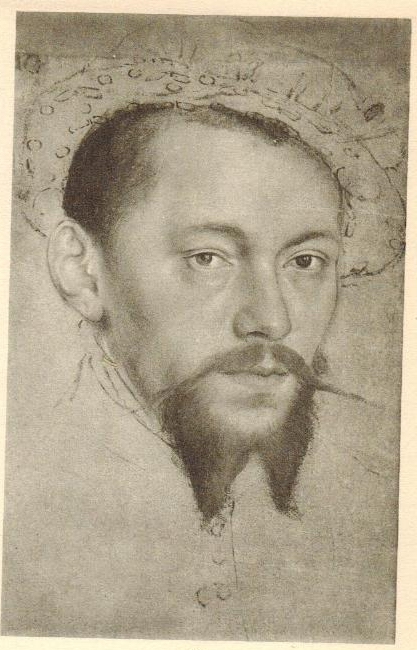
Portrait drawings of 16th-century noblemen: by Lucas Cranach the Elder (1472-1553), and by Lucas Cranach the Younger (1515-1586). First drawn by The Elder, and the second and third by The Younger.
. . . . .
“Home” / “Zu Hause”: an Irish poet in German
Posted: March 17, 2015 Filed under: English, German Comments Off on “Home” / “Zu Hause”: an Irish poet in German
Paula Meehan (born Dublin, Ireland, 1955. Meehan is an Irish poet and playwright, who studied at Trinity College, Dublin, and at Eastern Washington University, Washington State, U.S.A. )
Home
.
I am the blind woman finding her way home by a map of tune.
When the song that is in me is the song I hear from the world
I’ll be home. It’s not written down and I don’t remember the words.
I know when I hear it I’ll have made it myself. I’ll be home.
.
A version I heard once in Leitrim was close, a wet Tuesday night
in the Sean Relig bar. I had come for the session, I stayed
for the vision and lore. The landlord called time,
the music dried up, the grace notes were pitched to the dark.
When the jukebox blared out I’d only four senses and he left me senseless,
I’d no choice but to take to the road. On Grafton Street in November
I heard a mighty sound: a travelling man with a didgeridoo
blew me clear to Botany Bay. The tune too far back to live in
but scribed on my bones. In a past life I may have been Kangaroo,
rocked in my dreamtime, convict ships coming o’er the foam.
.
In the Puzzle Factory one winter I was sure I was home.
The talking in tongues, the riddles, the rhymes, struck a chord
that cut through the pharmaceutical haze. My rhythm catatonic,
I lulled myself back to the womb, my mother’s heart
beating the drum of herself and her world. I was tricked
by her undersong, just close enough to my own. I took then
to dancing; I spun like a Dervish. I swear I heard the subtle
music of the spheres. It’s no place to live, but –
out there in space, on your own, hung aloft the night.
The tune was in truth a mechanical drone;
I was a pitiful monkey jigging on cue. I came back to earth
with a land, to rain on my face, to sun in my hair. And grateful too.
.
The wisewomen say you must live in your skin, call it home,
no matter how battered or broken, misused by the world, you can heal.
This morning a letter arrived on the nine o’clock post.
The Department of Historical Reparation, and who did I blame?
The Nuns? Your Mother? The State? Tick box provided,
we’ll consider your case. I’m burning my soapbox, I’m taking
the very next train. A citizen of nowhere, nothing to my name.
I’m on my last journey. Though my lines are all wonky
they spell me a map that makes sense. Where the song that is in me
is the song I hear from the world, I’ll set down my burdens
and sleep. The spot that I lie on at last the place I’ll call home.
. . .
Paula Meehan
Zu Hause
.
Ich bin die blinde Frau, die ihren Heimweg nach einer Karte von Klängen findet.
Wenn das Lied in mir auch das Lied von der Welt ist,
bin ich zu Hause. Es steht nirgends geschrieben, und die Worte sind mir entfallen.
Wenn ich es höre, weiß ich, daß es von mir ist. Dann bin ich zu Hause.
.
Eine Version von einst in Leitrim kam nahe, ein nasser Dienstag abend
in der Sean Relig Bar. Ich war für die Session gekommen und blieb
um der Vision und Legenden willen. Der Wirt rief zum Ende,
die Musik erstarb, die Ornamente tappten ins Dunkel.
Als die Jukebox plärrte I’d only four senses and he left me senseless,
blieb mir nur noch der Aufbruch. Auf der Grafton Street im November
hörte ich einen mächtigen Sound: Ein Weitgereister mit einem Didgeridoo
blies mich geradewegs bis zur Botany Bay. Die Melodie zu vergangen, um sie zu leben,
aber eingeschrieben in meine Knochen. In einem früheren Leben war ich wohl Känguruh,
in meiner Traumzeit gewiegt, als Sträflingsschiffe das schäumende Meer querten.
.
Im Irrenhaus eines Winters war ich sicher, zu Hause zu sein.
Die phantastischen Reden, die Reime und Rätsel trafen Töne,
die durch den Pharmadunst schnitten. Katatonisch mein Rhythmus,
sank ich zurück in den Leib meiner Mutter, ihr Herz schlug
die Trommel ihrer ureigenen Welt. Ich ließ mich
von ihrer Begleitung, der meinen sehr nahe, verführen, begann dann
zu tanzen; ich wirbelte wie ein Derwisch. Ich schwöre, ich hörte
sehr leise die Sphärenmusik. Kein Ort zum Leben, doch –
da draußen im All, ganz allein, hoch droben über der Nacht.
Die Melodie war in Wahrheit ein mechanisches Summen;
ich ein erbärmlicher Affe, der auf Stichwort herumhüpfte. Abrupt
kehrte ich auf die Erde zurück, zu Regen im Gesicht und Sonne im Haar. Und
noch dankbar dazu.
.
Die weisen Frauen meinen, du mußt in deiner Haut leben, nenn das dein Zuhause,
egal wie geschlagen, gebrochen, mißbraucht von der Welt, du kannst heilen.
Heute morgen um neun kam ein Brief bei mir an.
Das Ministerium für Historische Wiedergutmachung, und wen beschuldigte ich?
Die Nonnen? Deine Mutter? Den Staat? Zutreffendes bitte ankreuzen,
Ihr Fall wird bearbeitet. Ich lasse Ideale Ideale sein und nehme
den allernächsten Zug. Bürgerin, besitzlos, von Nirgendwo.
.
Dies ist meine letzte Reise. Obwohl meine Zeilen ganz schief sind,
verraten sie mir eine Karte, die Sinn ergibt. Wo das Lied, das in mir ist,
das Lied von der Welt ist, werde ich meine Bündel absetzen
und schlafen. Wo ich am Schluß liege, den Platz werde ich Zuhause nennen.
. . .
Translation into German from English: Dörte Eliass
. . .
Two Irish women poets – in Spanish: Ailbhe Ní Ghearbhuigh and Caitríona Ní Chléirchín. Click on their names in the right-hand column!
. . . . .
The Three Kings / Die heil’gen drei Könige aus Morgenland
Posted: December 24, 2014 Filed under: English, English: Scots, German | Tags: Heinrich Heine Comments Off on The Three Kings / Die heil’gen drei Könige aus Morgenland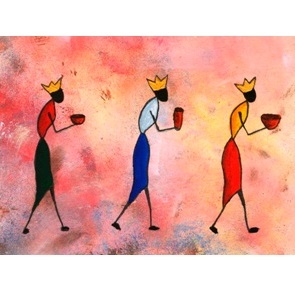 The Three Kings,
a Scots Vernacular poem, based on Heinrich Heine’s
Die heil’gen drei Könige aus Morgenland:
There were three kings cam frae the East;
They spiered in ilka clachan:
“O, which is the wey to Bethlehem,
My bairns, sae bonnily lachin’?”
.
O neither young nor auld could tell;
They trailed till their feet were weary.
They followed a bonny gowden starn,
That shone in the lift say cheery.
.
The starn stude ower the ale-hoose byre
Whaur the stable gear was hingin’.
The owsen mooed, the bairnie grat,
The kings begoud their singin’.
. . .
Scots words used – and their Standard English equivalents:
spiered = asked
clachan = village
bairns = children
lachin’ = laughing
starn = star
lift = sky
gear = equipment
owsen = oxen
bairnie = baby
grat = cried
begoud = began
. . .
Heine’s poem in the original German:
Die heil’gen drei Könige aus Morgenland
.
Die heil’gen drei Könige aus Morgenland,
Sie frugen in jedem Städtchen:
Wo geht der Weg nach Bethlehem,
Ihr lieben Buben und Mädchen?
.
Die Jungen und Alten, sie wußten es nicht,
Die Könige zogen weiter;
Sie folgten einem goldenen Stern,
Der leuchtete lieblich und heiter.
.
Der Stern blieb stehn über Josephs Haus,
Da sind sie hineingegangen;
Das Oechslein brüllte, das Kindlein schrie,
Die heil’gen drei Könige sangen.
. . . . .
Two “Autumn” Poems: translations by A.Z. Foreman
Posted: October 15, 2014 Filed under: Dino Campana, English, German, Italian, Rainer Maria Rilke Comments Off on Two “Autumn” Poems: translations by A.Z. Foreman
Dino Campana (1885-1932, Italy)
Autumn Garden
.
Unto the ghostly garden, unto the laurels mute
Of the green garlands,
Unto the autumn land
– one last salute!
Out to the dried hillsides
Reddened hard in the terminal sun,
Confounded into grumbles,
Gruff life afar is crying:
Crying to the dying sun that sheds
A blood that dyes the flowerbeds.
A brass band plays
Ear-piercingly away; the river fades
Out amidst the gilded sands. In the quiet
The great white statues stand at the bridgehead
Turned; and what was once is now no more.
And from the depths of quiet, as if it were a chorus
Soft and splendorous
Yearns its way to the heights of my terrace.
And in an air of laurel,
In an air of laurel, languorous and blade-bare,
Among the statues immortal under sundown,
She appears to me – is there.
. . .
Dino Campana
Giardino Autunnale
.
Al giardino spettrale al lauro muto
De le verdi ghirlande
A la terra autunnale
Un ultimo saluto!
A l’aride pendici
Aspre arrossate nell’estremo sole
Confusa di rumori
Rauchi grida la lontana vita:
Grida al morente sole
Che insanguina le aiole.
S’intende una fanfara
Che straziante sale: il fiume spare
Ne le arene dorate: nel silenzio
Stanno le bianche statue a capo i ponti
Volte: e le cose già non sono più.
E dal fondo silenzio come un coro
Tenero e grandioso
Sorge ed anela in alto al mio balcone:
E in aroma d’alloro,
In aroma d’alloro acre languente,
Tra le statue immortali nel tramonto
Ella m’appar, presente.
. . .
Rainer Maria Rilke (1875-1926, Bohemia-Austria-Germany)
Autumn Day
.
Lord: it is time. The summer days were grand.
Now set Thy shadows out across the sun-dials
And set the winds loose on the meadowland.
Bid the last fruits grow full upon the vine,
do them the good of two more southern days
then thrust them on to their fulfillment, chase
the final sweetness into bodied wine.
Whoever has no house yet will build none,
Whoever is alone will stay alone
And stay up, write long letters out, and go
Through avenues to wander on his own
Uneasily when leaves begin to blow.
. . .
Rainer Maria Rilke
Herbsttag
.
Herr: Es ist Zeit. Der Sommer war sehr groß.
Leg deinen Schatten auf die Sonnenuhren,
und auf den Fluren laß die Winde los.
Befiehl den letzten Früchten voll zu sein;
gieb ihnen noch zwei südlichere Tage,
dränge sie zur Vollendung hin und jage
die letzte Süße in den schweren Wein.
Wer jetzt kein Haus hat, baut sich keines mehr.
Wer jetzt allein ist, wird es lange bleiben,
wird wachen, lesen, lange Briefe schreiben
und wird in den Aleen hin und her
unruhig wandern, wenn die Blätter treiben.
. . .
Translations from the Italian and the German:
A. Z. Foreman
. . . . .
Sichtbar: e.e.cummings auf Deutsch / Silence: e.e.cummings in German
Posted: July 31, 2014 Filed under: E.E. Cummings, English, German Comments Off on Sichtbar: e.e.cummings auf Deutsch / Silence: e.e.cummings in German
stille
.ist
ein
shauender
vogel:der
wen
de;punkt,des
lebens
(suchend vor schnee
. . .
silence
.is
a
looking
bird:the
turn
ing;edge,of
life
(inquiry before snow
. . .
schnee heisst das
leben ist eine schwarze kannonad
e indie still
e go
ttllow
eg-weg)leben
?
baum3geister
sind Is 1 A ugen
Seltsam
vertraut
Gesicht
(warumlachend!unter:himmelsdiamanten
. . .
snow means that
life is a black cannonadin
g into silenc
e go
lliw
og-dog)life
?
tree3ghosts
are Is A eyes
Strange
known
Face
(whylaughing!among:skydiamonds
. . .
n
Ichtdl
n
gkann u
c
berTReff
e
n das
m
YsteriU
m
des
s
tilL.Sein
s
. . .
n
Othl
n
g can
s
urPas
s
the m
y
SteR
y
of
s
tilLnes
s
. . .
Wunderschön
ist das
unbe
deuten
des(lei
se)fal
lenden(da
nun
hier
all)s
chne
Es
. . .
Beautiful
is the
unmea
ning
of(sil
ently)fal
ling(e
ver
yw
here)s
Now
. . .
dies’ menschen herz
ist treu seiner
erde;so
jedermann’s welt
in
-t’ressiert ihn nicht(vom aus
sehen
anfühlen geschmack geruch
& klang
einer stille wer kann
ahnen
ge-
nau
was leben
tun wird)liebt
nichts
so serh so
wie(erst
das anko
-m-
me
-n)eine shneefloke tan-
zt
,auf
ihrem weg zum nie
-hier

r-f-e-p-u-e-h-s-a-g-r
welcher
al)s w(ir schau)en
aufnunrichht
PFEGERURASH
endz(u-
mDer):s
pr
iU
!ng:
T a
(n
kOmMeNd .gRrEaFsPuEh)
um
wieder(zu)ord(were)nen(en)d
,grashuepfer;

r-p-o-p-h-e-s-s-a-g-r
who
a)s w(e loo)k
upnowgath
PPEGORHRASS
eringint(o-
aThe):l
eA
!p:
S a
(r
rivinG .gRrEaPsPhOs)
to
rea(be)rran(com)gi(e)ngly
,grasshopper;
. . .
All e.e.cummings German translations © 2003, from the volume Sichtbar-Silence: Cummings coming into German, edited by Gudren M. Grabher
. . . . .
Wilson Alwyn Bentley: “Ice Flower” Photomicrographs
Posted: December 23, 2013 Filed under: English, German | Tags: Cryology Comments Off on Wilson Alwyn Bentley: “Ice Flower” Photomicrographs
Sabine Schiffner (born 1965, Bremen, Germany)
“Cryology – or the Study of Snow”
.
they say that when
wilson a. bentley* from montana
wasn’t playing
the clarinet he would grab
his camera and go
out into the snow
to capture snowflake after snowflake
in his attentive lens
recording them before they reverted
to drops of half-frozen water
and so revealing feathers
or many-pointed stars
or branching tree-like
mosaics or sparkling
constructs with disjointed frosted arms
and columns goblets even pyramids
countless crystalline forms
.
wilson a. bentley was nicknamed
flakey by his neighbours
they laughed at him behind his back
but needed him and his clarinet
for their concerts in church
they thought it was
ridiculous for him to try and hold on
to what disappears and
his obsession
made him a bit odd
what they didn’t know
was that he not only
saw the flakes but heard them
like the notes played
on a clarinet.
. . .
In the original German:
Sabine Schiffner
“Kryologie”
(die lehre vom schnee)
.
von wilson a. bentley aus montana
wird berichtet er habe wenn er nicht
eben klarinette spielte die kamera
zur hand genommen und sei mit ihr
raus aus dem haus und in den schnee getreten und
habe zärtlich flock’ um flocke aufgefangen
und vor die linse komplimentiert wo er sie
dokumentierte bevor sie wieder wurden was sie vorher
waren nämlich ein tropfen halb gefrornes wasser mit
einer gänsefeder hingewischt sie stellten sich
als stern mit viel verschiednen enden dar
oder dendritengruppen mit diversen
plättchen oder als strahlenförmige
gebilde mit abgebrochnem arm
mit reif als säule als pokal und micht zuletze als pyramide
unendlich kristalline formen
wilson a. bentley heiss bei seinen
nachbarn snowflake sie
lachten hinter seinem rücken über ihn jedoch sie brauchten
ihn und seine klarinette fur die konzerte
in der kirche sie hielten
es für lächerlich das festzuhalten was
sofort wieder vergeht und dass er sich
so sehr gezwungen sah es festzuhalten
machte ihn fremd
sie wussten nicht dass er die flocken
night nur sah sondern auch hörte
wie die musik die seine klarinette
spielt

* Wilson Alwyn Bentley (February 9th, 1865 – December 23rd, 1931) was, in fact, from Jericho, Vermont, USA – not from the state of Montana. He became famous as a photographer of snowflakes.
Bentley was fascinated by snow crystals as a teenager and attempted to draw the flakes he placed under a microscope – but they were too complex to draw before they melted. And so he attached a bellows camera to a compound microscope and successfully “captured” an image of a snowflake when he was 20 years old. His procedure became to catch a crystal on a blackboard then transfer it quickly to a microscope slide. He called snowflakes “ice flowers”. The type of glass-plate photographs he made – several thousand of them – are known as “photomicrographs”.
. . .
Sabine Schiffner’s Kryologie (die lehre vom schnee) from her 2007 book of poems, Dschinn, is here featured in a translation from German into English © Paul Archer

All Souls Day: “November Rose”, “Autumn Breeze” and “On My Child – Who Died Early” / Allerseelen gedichte: Stefan George, Friedrich Rückert, Rosa Maria Assing
Posted: November 2, 2013 Filed under: English, German | Tags: All Souls Day poems Comments Off on All Souls Day: “November Rose”, “Autumn Breeze” and “On My Child – Who Died Early” / Allerseelen gedichte: Stefan George, Friedrich Rückert, Rosa Maria Assing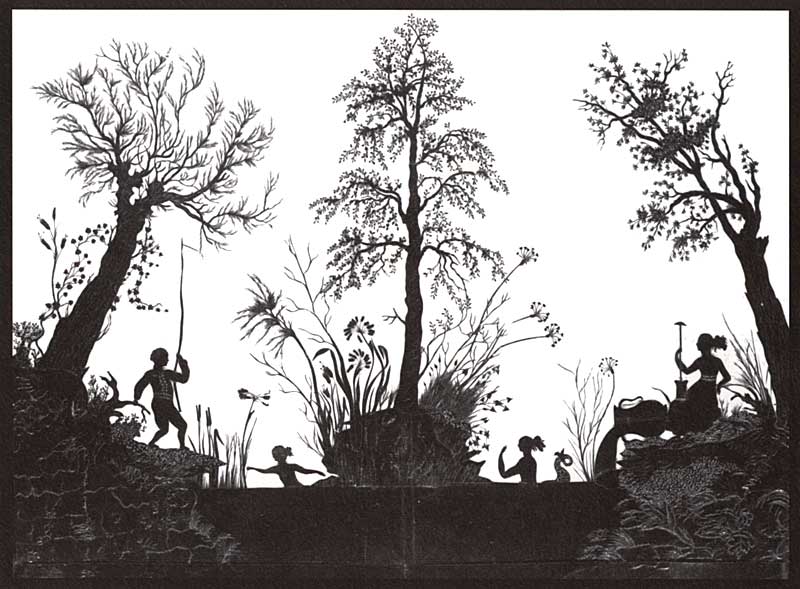 .
.
Stefan George (1868-1933)
“November Rose”
.
Tell me, wan rose there,
Why do you continue in such a dreary place?
The autumn is already sinking on the lever of time
November clouds are already drawing towards the mountains
Why do you continue alone, pale rose?
The last of your companions and sisters
Fell dead and petalless to the ground yesterday
And lies interred in its mother’s womb…
Ah, don’t admonish me for hurrying!
I’ll wait a short while yet.
I stand on the grave of a youth:
He of many hopes and charms
How did he die? Why? God only knows!
Before I fade, before I wane
I yet want to adorn
His fresh grave
On the day of death.
. . .
Stefan George
“Novemberrose”
.
Sag mir blasse Rose dort
Was stehst du noch an so trübem ort?
Schon senkt sich der herbst am zeitenhebel
Schon zieht an den bergen novembernebel.
Was bleibst du allein noch blasse rose?
Die letzte deiner gefährten und schwestern
Fiel tot und zerblättert zur erde gestern
Und liegt begraben im mutterschoosse…
Ach mahne mich nicht dass ich mich beeile!
Ich warte noch eine kleine weile.
Auf eines jünglings grab ich stehe:
Er vieler hoffnung und entzücken
Wie starb er? Warum? Gott es wissen mag!
Eh ich verwelke eh ich vergehe
Will ich sein frisches grab
noch schmücken
Am totentag.
. . .
Friedrich Rückert (1788-1866)
“Autumn Breeze”
.
Heart, already so old and yet not wise,
Do you hope from day to day,
That what the blossoming Spring didn’t bring you
Will yet come to you in Fall!
.
The sportive wind doesn’t leave the bush alone,
Always flattering, always caressing.
Its breath unfurls the roses in the morning
And strews the roses in the evening.
.
The sportive wind doesn’t leave the bush alone
Until it strips it bare.
Everything, Heart, that we loved and lyricized
Is a wind and a breath.
. . .
Friedrich Rückert
“Herbsthauch”
.
Herz, nun so alt und noch immer nicht klug,
Hoffst du von Tagen zu Tagen,
Was dir der blühende Frühling nicht trug,
Werde der Herbst dir noch tragen!
.
Läßt doch der spielende Wind nicht vom Strauch,
Immer zu schmeicheln, zu kosen.
Rosen entfaltet am Morgen sein Hauch,
Abends verstreut er die Rosen.
.
Läßt doch der spielende Wind nicht vom Strauch,
Bis er ihn völlig gelichtet.
Alles, o Herz, ist ein Wind und ein Hauch,
Was wir geliebt und gedichtet.
. . .
 .
.
Rosa Maria Assing (1783-1840)
“On My Child – Who Died Early”
.
We watched, entranced, as a pure little flame
Rose up between us out of the fire of our love
In the life of our sweet beloved child;
And for us the most joyful celebration began!
.
The flame daily lit our way towards new
And sweeter pleasures, and with joyous trembling
We united in the dearest pursuit of the heart,
To care for what was most precious to us.
.
Then death came treading with heavy steps;
The flame that lit our lives so brilliantly
Was extinguished into our deepest trembling.
.
Then life seemed cold and dark to us,
Our faces and eyes were wet with tears;
We shuddered, deeply sunken in grief.
. . .
Already spring breezes are blowing gently again,
And the sweet fragrance of the violets is wafting,
The wind plays with fresh grass and foliage,
And I hear the nightingale lifting her song.
.
So many other things are being and growing,
Everything pushes towards light and life;
But, ah, my tender child can only wilt,
It shall never see another springtime.
.
Not spring breezes, not violets, nightingales,
Nor whatever other pleasures the spring brings,
None of these shall come into your life,
.
For you were devoured so soon by the dark grave!
And for me, as I languish in sorrow over you,
Nothing blooms in spring but my deep woe!
.
(1818)
. . .
Rosa Maria Assing
“Auf mein früh gestorbenes Kind”
.
Wir sahn entzückt aus unsrer Liebe Feuer
Sich zwischen uns ein Flämmchen rein erheben
In des geliebten süßen Kindes Leben;
Und uns begann des höchsten Glückes Feier!
.
Die Flamme glänzte uns zu täglich neuer
Und süßrer Freude, und mit frohem Beben
Vereinten wir des Herzens liebstes Streben,
Zu pflegen was uns über alles theuer.
.
Da kam mit schwerem Tritt der Tod gegangen;
Die Flamme, die so herrlich uns geleuchtet,
Die löschte er zu unserm tiefsten Beben.
.
Nun scheinet kalt und dunkel uns das Leben,
Mit Thränen ist Gesicht und Aug’ befeuchtet;
Wir stehn erschüttert, tief vom Schmerz befangen.
. . .
Schon wehen wieder Frühlingslüfte lind,
Und Veilchen lassen süßen Duft entschweben,
Mit jungem Gras und Laube spielt der Wind,
Auch hör’ ich Nachtigall ihr Lied erheben.
.
So viel auch Wesen und Gewüchse sind,
Es dränget alles sich zum Licht und Leben;
Nur welken mußte, ach, mein zartes Kind,
Es sollte keinen Frühling je erleben!
.
Nicht Frühlingsluft, nicht Veilchen, Nachtigallen,
Und was noch sonst der Frühling Süßes bringt,
Nichts davon sollte in dein leben fallen,
.
Da dich so früh das dunkle Grab verschlingt!
Und mir, die ich in Schmerz um dich vergehe,
Blüht nichts im Frühling als mein tiefes Wehe!
.
(1818)
. . .
Translations from the German © Aaron Swan
. . .
Images:
Rosa Maria Assing_Landschaft mit Quellgöttinnen_a silhouette scene_paper cutout_made by the poet in 1830
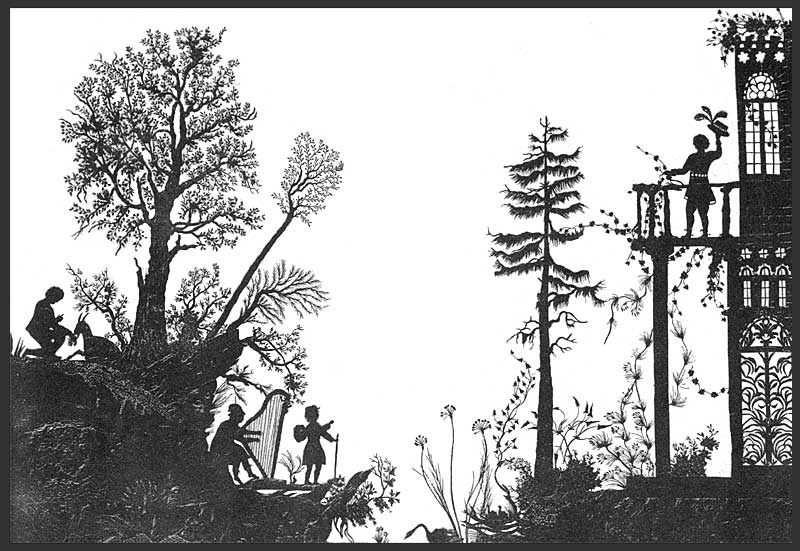
Rosa Maria Assing_Märchenlandschan mit Altan_a silhouette scene_paper cutout_made by the poet in 1830
. . . . .
Egon Schiele: Ich bin Mensch, ich liebe / Den Tod und Liebe / Das Leben. “I am a Human Being – I love Death and Love – They are alive.”
Posted: October 31, 2013 Filed under: A FEW FAVOURITES / UNA MUESTRA DE FAVORITOS, Egon Schiele, English, German | Tags: German Expressionist poets Comments Off on Egon Schiele: Ich bin Mensch, ich liebe / Den Tod und Liebe / Das Leben. “I am a Human Being – I love Death and Love – They are alive.”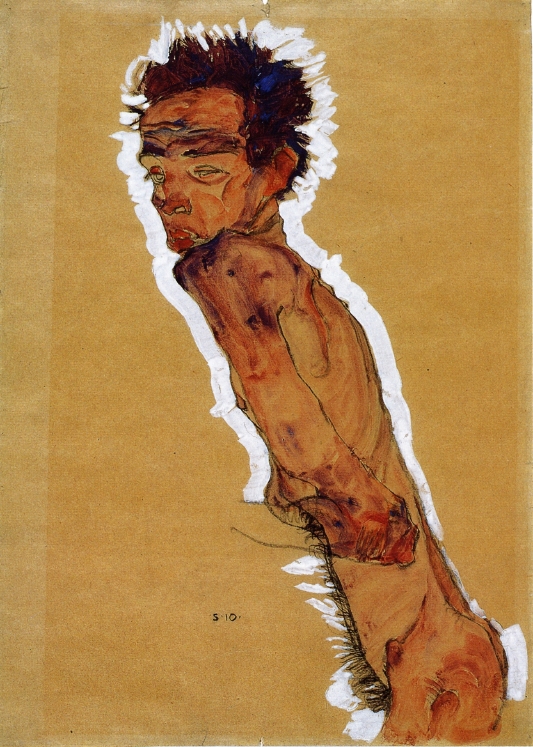 ZP_Egon Schiele_Selfportrait_Male nude in profile, facing left_1910
.
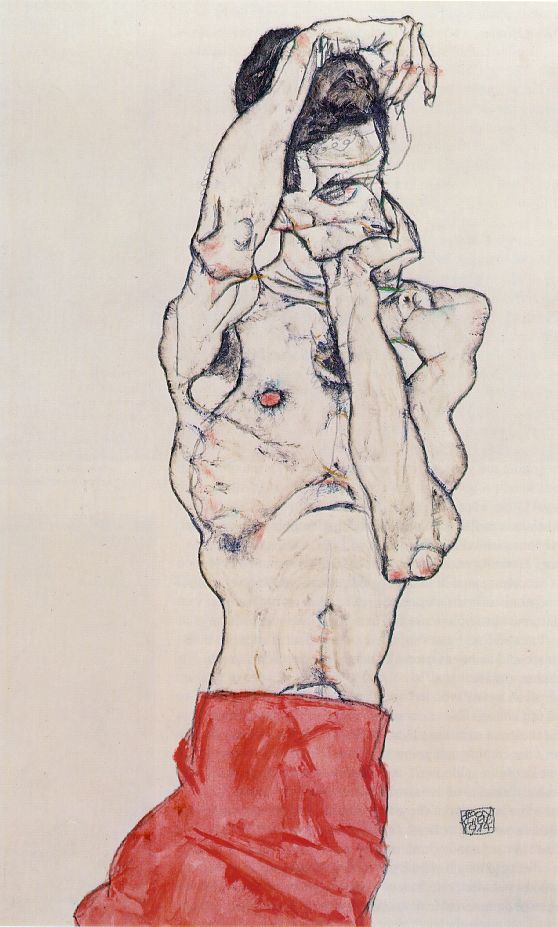
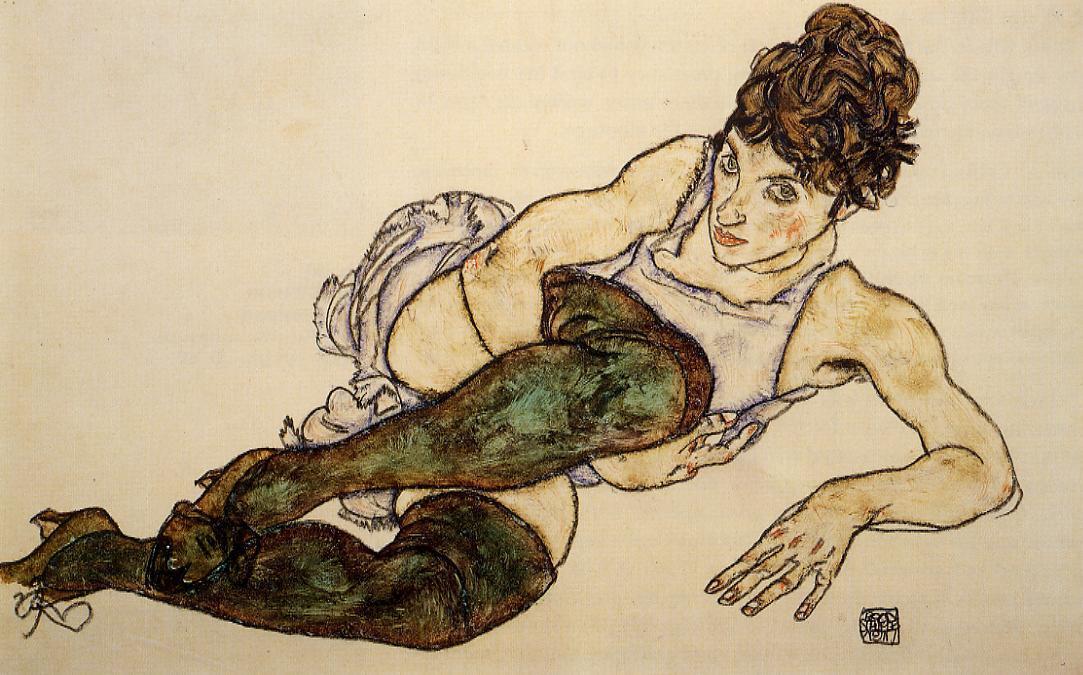
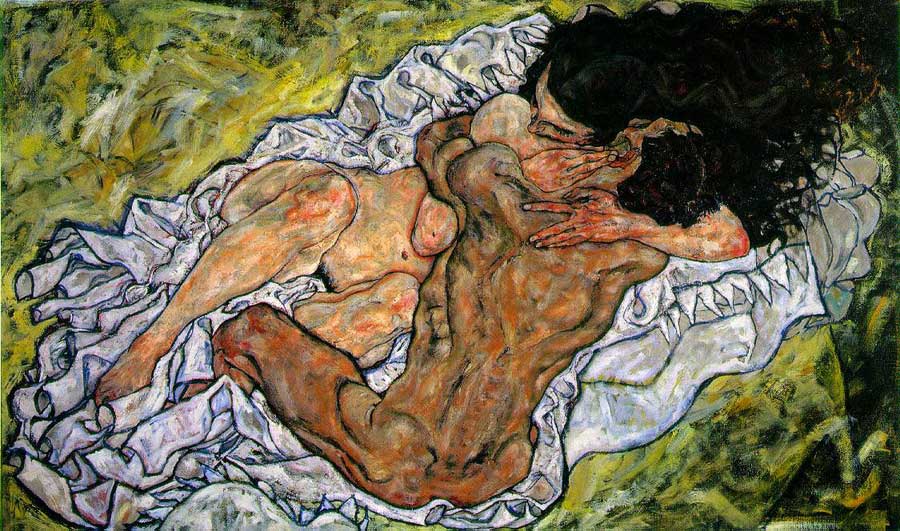
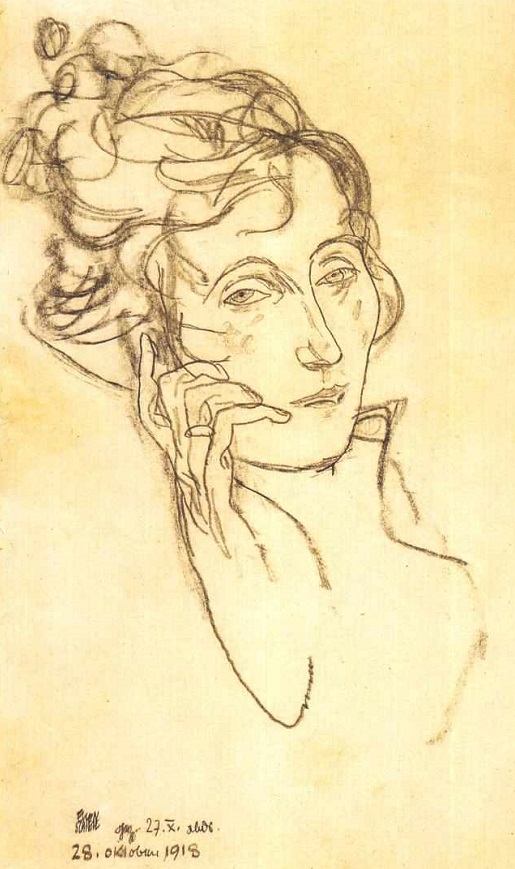
Strange Austrian “wunderkind” Egon Schiele was the son of a railroad station-master in Tulln and a mother from Krumau in Bohemia (Czechoslovakia). Schiele began to draw at the age of 18 months, and was disturbingly precocious when it came to early explorations of his own sexuality. Schiele’s paintings and drawings are always – unmistakably – his, and the artist died on this day (October 31st) in 1918, at the age of 28. One of the many millions who succumbed to the ineptly-named “Spanish Flu” pandemic which began in January 1918 – before the end of what was then known as The Great War – and lasted until December 1920 – Schiele’s art had had, even before the War, so much of Death about it – and yet also of Eros, and of Love. One of the artist’s own poems – and he did write a handful of them to accompany several canvases – states simply: Ich bin Mensch, ich liebe / Den Tod und Liebe / Das Leben. “I am a human being – I love Death and Love – they are alive.” Schiele’s wife Edith, six months pregnant, died of the “Spanish Flu” on October 28th, 1918, and Schiele, himself already extremely ill, made several sketches of her as she lay dying. He was gone just three days later.
.
Translators Will Stone and Anthony Vivis wrote, in an issue of The London Magazine: “In one of his untitled poems Schiele talks of a bird where ‘a thousand greens are reflected in its eyes’. That this was written by an artist of Schiele’s calibre infuses the image with added significance. Who but he could know the shade created by a thousand greens and hold it long enough to record? What matters is not literally that a thousand greens reflect in the bird’s eye, but the possibility that they could. The green of the eye is so overwhelming that in his determination to see truth above all else the precocious poet-artist has glutted himself with a thousand variations within a single colour. While admitting the impossibility of capturing the reality of nature – like a translator faced with a text which appears to defy intra-linguistic interpretation – Schiele takes up the challenge nevertheless. It is a microcosm of the artistic calling: proceeding with creation and conceding defeat at the same moment. The sense of precariousness, the constant wavering of the boundary between lucidity and excruciation, is perhaps why Schiele’s paintings score so deeply into us even today [April 2012].”
.
The Viennese, bourgeois-art-appreciating public had found Schiele’s un-pretty style and colour palette – often there were grey-green hues for skin, as if the living were putrefying – and his candid, awkward-limbed sexuality / unflattering poses / the angst *of his nudes – difficult to look upon. Yet he was really a proto–Expressionist who was leading the way for Expressionism** – that most powerful German artistic movement of the first quarter of the 20th century. Schiele’s influences were Vincent Van Gogh, “Art-Nouveau”, and Gustav Klimt – all from his boyhood – but it’s the poets, not visual artists, of the decade from 1910 forward, that explored – like Schiele was doing – similar discomfiting emotional and psychological “territories”. And so, we have placed a selection of their verses alongside poems of and images of paintings and drawings by Egon Schiele.
.
* Angst is a great-sounding word. It reached German – and English – via the Danish language and an 1844 treatise by the philosopher Kierkegaard. Angst means Existential anxiety or fear.
** German Expressionism – a definition from Ruth J. Owen:
“A Modernist mode, mainly in the second decade of the 20th century; perspective of angst and absurdity; disturbing visions of downfall and decay; pathological world of the crippled and insane, and images of the city and war. ‘Aufbruch’ (an awakening or departure from) becomes ubiquitous – a new era; dislocated colour, shrill tone; the grotesque, deathliness and dissolution.”
. . .
Egon Schiele (1890-1918)
“Ein Selbstbild” / “Self-Portrait” (1910)
.
Ich bin für mich und die, denen
Die durstige Trunksucht nach
Freisein bei mir alles schenkt,
und auch für alle, weil alle
ich auch Liebe, – Liebe
.
Ich bin von vornehmsten
Der Vornehmste
Und von Rückgebern
Der Rückgebigste
.
Ich bin Mensch, ich liebe
Den Tod und Liebe
Das Leben.
. . .
Egon Schiele
“Sensation”
.
High vast winds turned my spine to ice
and I was forced to squint.
On a scratchy wall I saw
the entire world
with all its valleys, mountains and lakes,
with all the animals running around
shadows of trees and the patches of sun
reminded me of clouds.
I strode upon the earth
and had no sense of my limbs
I felt so light.
. . .
“Empfindung”
.
Hohe Grosswinde machten kalt mein Rückgrat
und da schielte ich.
Auf einer krätzigen Mauer sah ich
die ganze Welt
mit allen Tälern und Bergen und Seen,
mit all den Tieren, die da umliefen –
Die Schatten der Bäume und die Sonnenflecken erinnerten
mich an die Wolken.
Auf der Erde schritt ich
und spürte meine Glieder nicht,
so leicht war mir.
. . .
Egon Schiele
“Music while drowning”
.
In no time the black river yoked all my strength
I saw the lesser waters great
and the soft banks steep and high.
.
Twisting I fought
and heard the waters within me,
the fine, beautiful black waters –
then I breathed golden strength once more.
The river ran rigid and more strongly.
. . .
“Musik beim ertrinken”
.
In Momenten jochte der schwarze Fluss meine ganzen Kräfte.
Ich sah die kleinen Wasser gross
Und die sanften Ufer steil und hoch.
.
Drehend rang ich
und hörte die Wasser in mir,
die guten, schönen Shwarzwasser –
Dann atmete ich wieder goldene Kraft.
Der Strom strömte starr und stärker.
.
Egon Schiele’s poems: translations from the German © Will Stone and Anthony Vivis
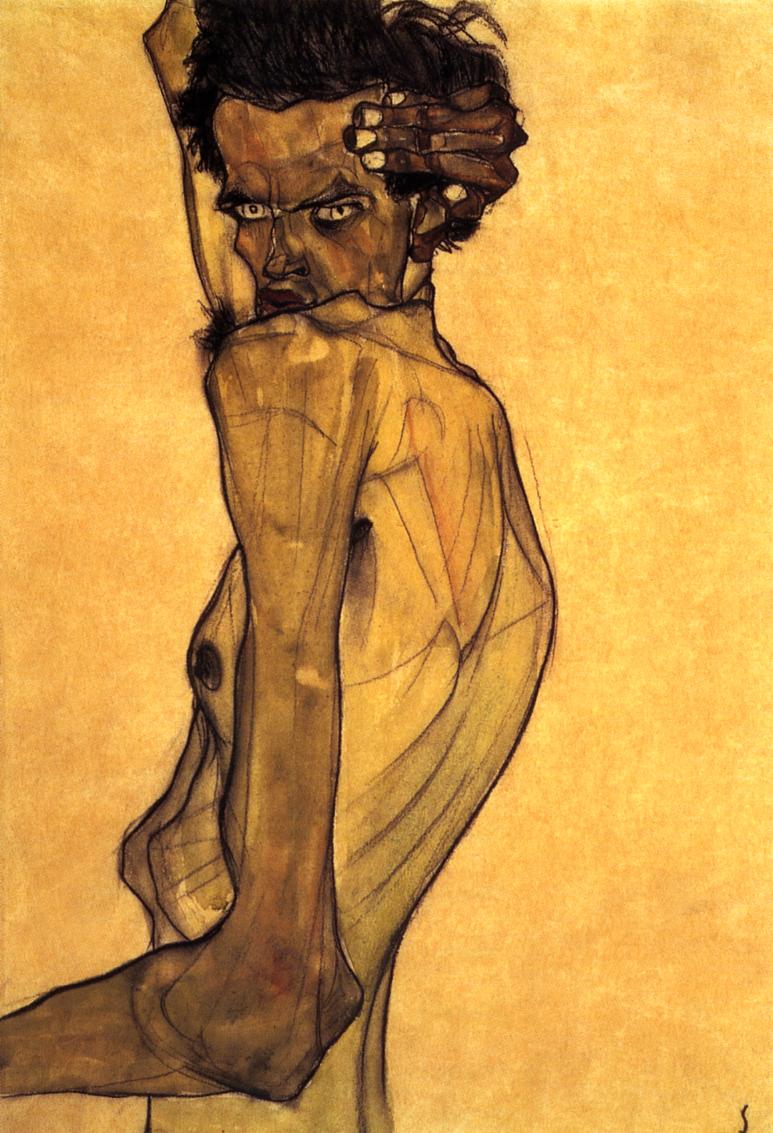

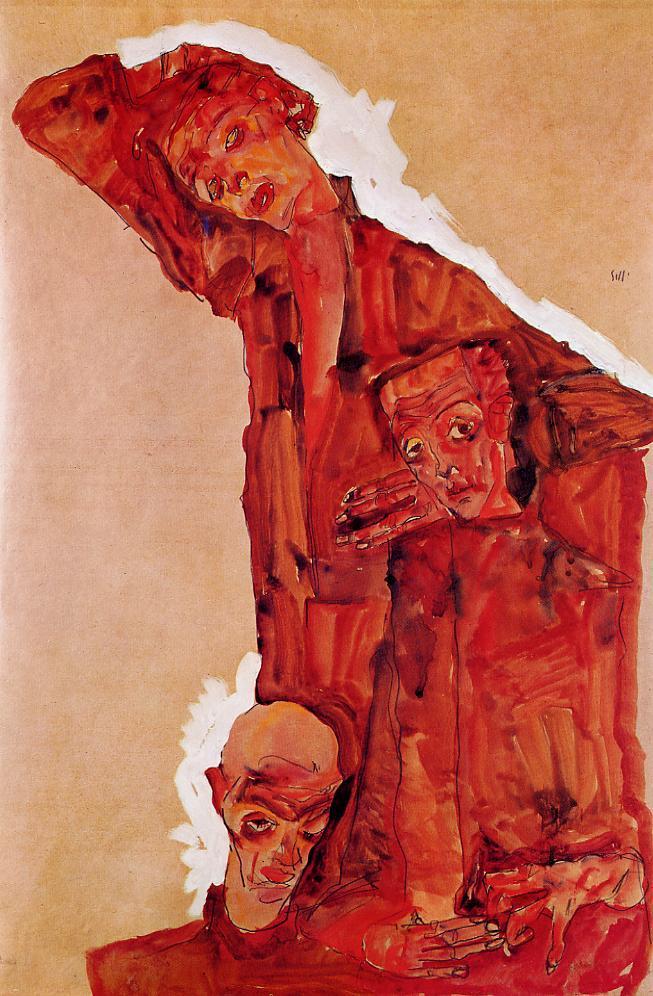
. . .
Else Lasker-Schüler (1869-1945)
“Oh, let me leave this world”
.
Then you will cry for me.
Copper beeches pour fire
On my warlike dreams.
Through dark underbrush
I crawl,
Through ditches and water.
Wild breakers beat
My heart incessantly;
The enemy within.
Oh let me leave this world!
But even from far away
I’d wander – a flickering light –
Around God’s grave.
. . .
“O ich möcht aus der Welt”
.
Dann weinst du um mich.
Blutbuchen schüren
Meine Träume kriegerisch.
Durch finster Gestrüpp
Muß ich
Und Gräben und Wasser.
Immer schlägt wilde Welle
An mein Herz;
Innerer Feind.
O ich möchte aus der Welt!
Aber auch fern von ihr
Irr ich, ein Flackerlicht
Um Gottes Grab.
. . .
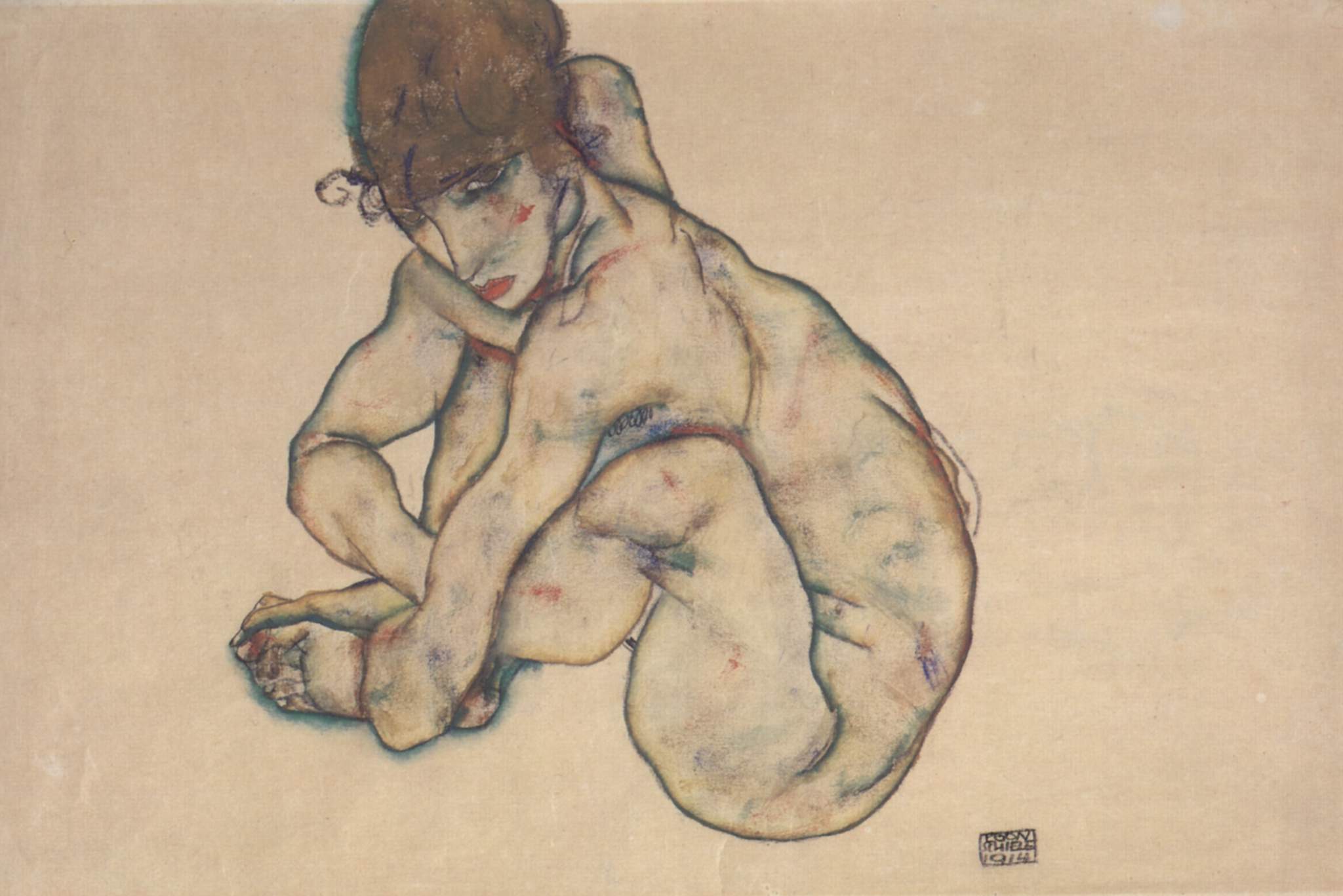
. . .
|
Gottfried Benn (1886-1956) D-Zug Braun wie Kognak. Braun wie Laub. Rotbraun. Malaiengelb. |
Gottfried Benn Express Train Brown as cognac. Brown as leaves. Red-brown. Malayan yellow. . (1912) Translation from the German © Michael Hamburger |
|
Gottfried Benn Vor Einem Kornfeld Vor einem Kornfeld sagte einer: |
Gottfried Benn Before a Cornfield Before a cornfield he said: . (1913) Translation from the German © SuperVert |
.
Georg Heym (1887-1912)
“Umbra vitae”
.
Die Menschen stehen vorwärts in den Straßen
Und sehen auf die großen Himmelszeichen,
Wo die Kometen mit den Feuernasen
Um die gezackten Türme drohend schleichen.
Und alle Dächer sind voll Sternedeuter,
Die in den Himmel stecken große Röhren.
Und Zaubrer, wachsend aus den Bodenlöchern,
In Dunkel schräg, die einen Stern beschwören.
Krankheit und Mißwachs durch die Tore kriechen
In schwarzen Tüchern. Und die Betten tragen
Das Wälzen und das Jammern vieler Siechen,
und welche rennen mit den Totenschragen.
Selbstmörder gehen nachts in großen Horden,
Die suchen vor sich ihr verlornes Wesen,
Gebückt in Süd und West, und Ost und Norden,
Den Staub zerfegend mit den Armen-Besen.
Sie sind wie Staub, der hält noch eine Weile,
Die Haare fallen schon auf ihren Wegen,
Sie springen, daß sie sterben, nun in Eile,
Und sind mit totem Haupt im Feld gelegen.
Noch manchmal zappelnd. Und der Felder Tiere
Stehn um sie blind, und stoßen mit dem Horne
In ihren Bauch. Sie strecken alle viere
Begraben unter Salbei und dem Dorne.
Das Jahr ist tot und leer von seinen Winden,
Das wie ein Mantel hängt voll Wassertriefen,
Und ewig Wetter, die sich klagend winden
Aus Tiefen wolkig wieder zu den Tiefen.
Die Meere aber stocken. In den Wogen
Die Schiffe hängen modernd und verdrossen,
Zerstreut, und keine Strömung wird gezogen
Und aller Himmel Höfe sind verschlossen.
Die Bäume wechseln nicht die Zeiten
Und bleiben ewig tot in ihrem Ende
Und über die verfallnen Wege spreiten
Sie hölzern ihre langen Finger-Hände.
Wer stirbt, der setzt sich auf, sich zu erheben,
Und eben hat er noch ein Wort gesprochen.
Auf einmal ist er fort. Wo ist sein Leben?
Und seine Augen sind wie Glas zerbrochen.
Schatten sind viele. Trübe und verborgen.
Und Träume, die an stummen Türen schleifen,
Und der erwacht, bedrückt von andern Morgen,
Muß schweren Schlaf von grauen Lidern streifen.
. . .
Georg Heym
“Umbra vitae” (The Shadow of Life)
.
The people stand forward in the streets
They stare at the great signs in the heavens
Where comets with their fiery trails
Creep threateningly about the serrated towers.
And all the roofs are filled with stargazers
Sticking their great tubes into the skies
And magicians springing up from the earthworks
Tilting in the darkness, conjuring the one star.
Sickness and perversion creep through the gates
In black gowns. And the beds bear
The tossing and the moans of much wasting
They run with the buckling of death.
The suicides go in great nocturnal hordes
They search before themselves for their lost essence
Bent over in the South and West and the East and North
They dust using their arms as brooms.
They are like dust, holding out for a while
The hair falling out as they move on their way,
They leap, conscious of death, now in haste,
And are buried head-first in the field.
Yet occasionally they twitch still. The animals of the field
Blindly stand around them, poking with their horn
In the stomach. They lie on all fours
Buried under sage and thorn.
The year is dead and emptied of its winds
That hang like a coat covered with drops of water
And eternal weather, which bemoaning turns
From cloudy depth again to the depths.
But the seas stagnate. The ships hang
Rotting and querulous in the waves,
Scattered, no current draws them
And the courts of all heavens are sealed.
The trees fail in their seasonal change
Locked in their deadly finality
And over the decaying path they spread
Their wooden long-fingered hands.
He who dies undertakes to rise again,
Indeed he just spoke a word.
And suddenly he is gone. Where is his life?
And his eyes are like shattered glass.
Many are shadows. Grim and hidden.
And dreams which slip by mute doors,
And who awaken, depressed by other mornings,
Must wipe heavy sleep from greyed lids.
.
(1912)
.
Heym translation © Scott Horton
. . . . .
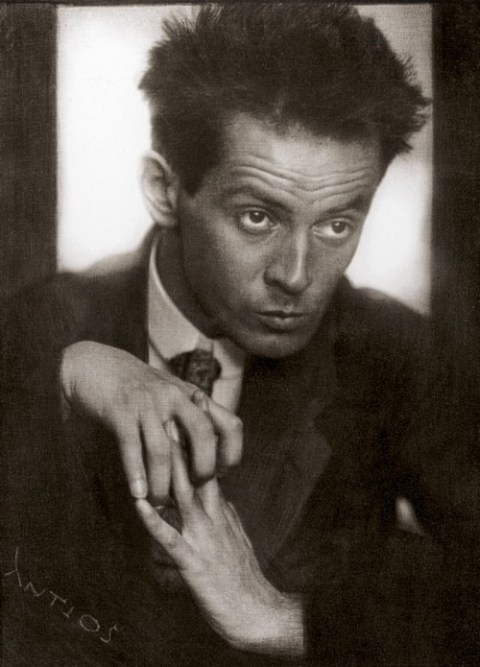 ZP_Egon Schiele_photographed at the age of 24 by Anton Josef Trcka_1914
.
Images (paintings and drawings) featured here:
Egon Schiele_Selfportrait_Male nude in profile, facing left_1910
Egon Schiele_Selfportrait with arm twisted above head_1910
Egon Schiele_Reclining male nude_1911
Egon Schiele_Composition with three male figures_Selfportrait_1911
Egon Schiele_Male nude with a red loincloth_1914
Egon Schiele_Sitzender weiblicher Akt_Female nude sitting_1914
Egon Schiele_Death and the Maiden_1915
Egon Schiele_Sitzende frau mit hochgezogenem knie_The model was – possibly – Wally Neuzil (1894 – 1917). Neuzil was a former model for Gustav Klimt and she became Schiele’s model / muse / lover before his marriage to Edith Harms.
Egon Schiele_Reclining woman with green stockings_Adele Harms_1917
Egon Schiele_Embrace_Lovers II_1917
Egon Schiele_Edith sterbend_Edith dying_October 28th 1918_the last drawing by Schiele
. . . . .
Aki no ki no…Autumn begins…Стихи про осень…Autumn poems…
Posted: September 21, 2012 Filed under: English, German, Japanese, Russian, Spanish Comments Off on Aki no ki no…Autumn begins…Стихи про осень…Autumn poems…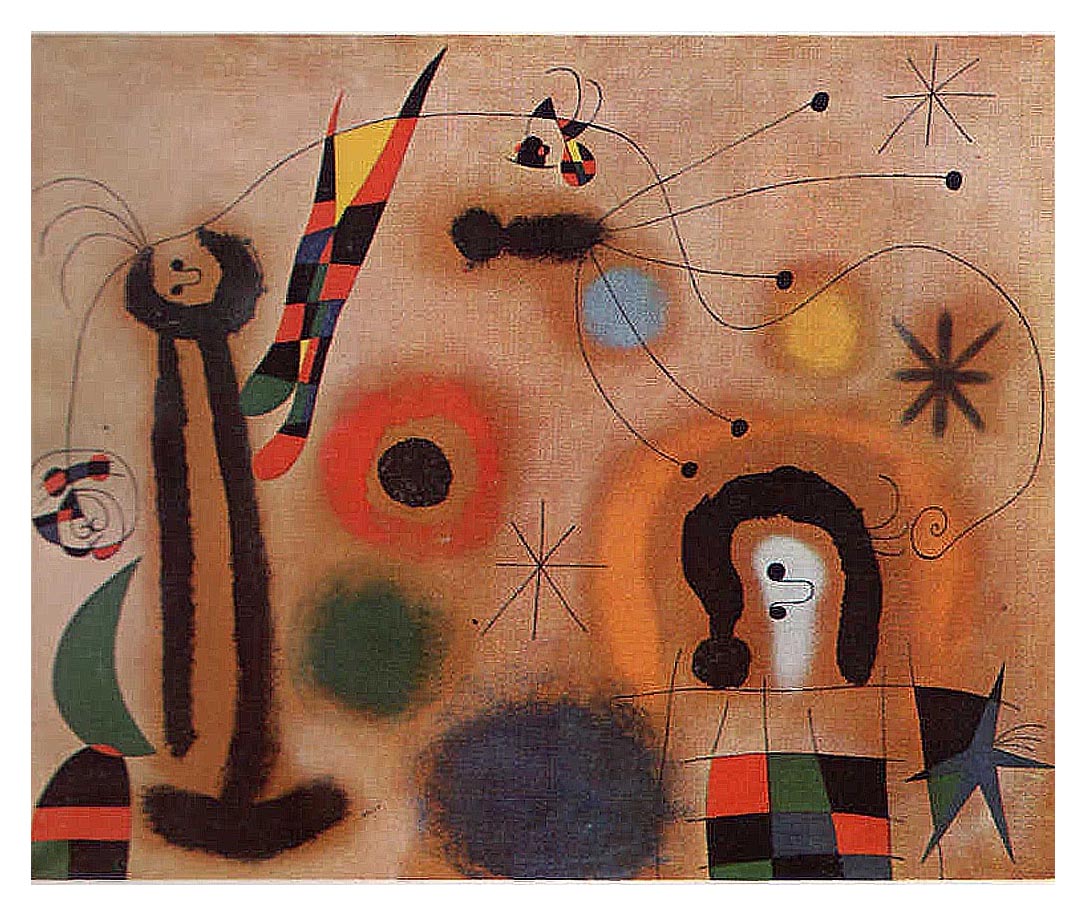
Марина Ивановна Цветаева (1892-1941)
.
Солнцем жилки налиты — не кровью —
На руке, коричневой уже.
Я одна с моей большой любовью
К собственной моей душе.
.
Жду кузнечика, считаю до ста,
Стебелёк срываю и жую…
— Странно чувствовать так сильно и так просто
Мимолётность жизни — и свою.
.
Marina Tsvetaeva (1892-1941)
.
My veins are filled with sun –
Not blood –
Brown is a hand – already like straw.
Alone I am with this strong love,
With love to my own wandering soul.
.
Waiting for a grasshopper
I count to ten,
Gathering flower-stalks to taste it…
– Feeling so simple, feeling so strange
The transience of life –
And me.
*
А́нна Андре́евна (1889-1966)
.
Есть в осени первоначальной
Короткая, но дивная пора —
Весь день стоит как бы хрустальный,
И лучезарны вечера…
.
Anna Akhmatova (1889-1966)
.
At the beginning of autumn
There is a short but wondrous time
When days seem made of crystal
And evenings are radiant…
*
Александр Блок (1880-1921)
.
Медлительной чредой нисходит день осенний,
Медлительно крутится желтый лист,
И день прозрачно свеж, и воздух дивно чист –
Душа не избежит невидимого тленья.
.
Так, каждый день стареется она,
И каждый год, как желтый лист кружится,
Всё кажется, и помнится, и мнится,
Что осень прошлых лет была не так грустна.
.
Alexander Blok (1880-1921)
.
In slow motion an autumn day is coming,
A yellow leaf is spinning tardily,
The day is quite fresh, the air divinely clear –
My soul shall not avoid its unseen fading.
.
Thus, one grows older with every day,
And every year spins like a yellow leaf,
As I enliven memories, it seems to me
That autumns of years past were not so sad…
*
Goethe (1749-1832)
“Herbstgefühl”
.
Fetter grüne, du Laub,
Am Rebengeländer
Hier mein Fenster herauf!
Gedrängter quellet,
Zwillingsbeeren, und reifet
Schneller und glänzend voller!
Euch brütet der Mutter Sonne
Scheideblick, euch umsäuselt
Des holden Himmels
Fruchtende Fülle;
Euch kühlet des Mondes
Freundlicher Zauberhauch,
Und euch betauen, ach!
Aus diesen Augen
Der ewig belebenden Liebe
Voll schwellende Tränen.
.
Goethe (1749-1832)
“Autumn Emotion”
.
A fuller green, you leaves,
up here to my window, along the grape trellis!
Swell more crowdedly,
indistinguishable berries,
and ripen more quickly
and more fully gleaming!
On you broods the mother sun’s parting glance,
all around you rustles the lovely sky’s fruitful abundance;
you are cooled by the moon’s kindly and magical breath,
you are bedewed
—ah!—
by the tears overflowing from
these eyes of eternally enlivening love.
*
Pablo Neruda (1904-1973)
“Te recuerdo como eras…”
.
Te recuerdo como eras en el último otoño.
Eras la boina gris y el corazón en calma.
En tus ojos peleaban las llamas del crepúsculo.
Y las hojas caían en el agua de tu alma.
.
Apegada a mis brazos como una enredadera,
las hojas recogían tu voz lenta y en calma.
Hoguera de estupor en que mi sed ardía.
Dulce jacinto azul torcido sobre mi alma.
.
Siento viajar tus ojos y es distante el otoño:
boina gris, voz de pájaro y corazón de casa
hacia donde emigraban
mis profundos anhelos
y caían mis besos alegres como brasas.
.
Cielo desde un navío. Campo desde los cerros.
Tu recuerdo es de luz, de humo, de estanque en calma!
Más allá de tus ojos ardían los crepúsculos.
Hojas secas de otoño giraban en tu alma.
.
Pablo Neruda (1904-1973)
“I remember you as you were…”
.
I remember you as you were that final autumn.
You were: grey beret, still heart.
In your eyes the flames of twilight fought on.
And the leaves fell in the water of your soul.
.
Clasping my arms like a climbing plant,
Leaves harvested your voice slow, at peace.
Bonfire of awe where my thirst was burning.
Sweet blue hyacinth twisted upon my soul.
.
I feel your eyes traveling, and the autumn is far off:
grey beret, voice of a bird, heart like a house,
towards which my deep longings migrated
and my kisses fell, happy as embers.
.
Sky from a ship. Field from the hills:
Your memory is made of light, of smoke, of a still pond!
Beyond your eyes, farther on, the evenings were blazing.
Dry autumn leaves revolved in your soul.
*
Robert Louis Stevenson (1850-1894)
“Autumn Fires”
.
In the other gardens
And all up the vale,
From the autumn bonfires
See the smoke trail!
.
Pleasant summer over
And all the summer flowers,
The red fire blazes,
The grey smoke towers.
.
Sing a song of seasons!
Something bright in all!
Flowers in the summer,
Fires in the fall!
*
藤原敏行
秋立つ日よめる
あききぬとめにはさやかに見えぬども
風のをとにぞおどろかれぬる
.
aki tatsu hi yomeru
aki kinu to me ni wa sayaka ni mienudomo
kaze no oto ni zo odorokarenuru
.
Fujiwara no Toshiyuki 藤原敏行
(10th century, Japan)
.
“Composed on the first day of Autumn…”
That autumn has come is not obvious to the eye,
rather, I was surprised by the sound of the wind.
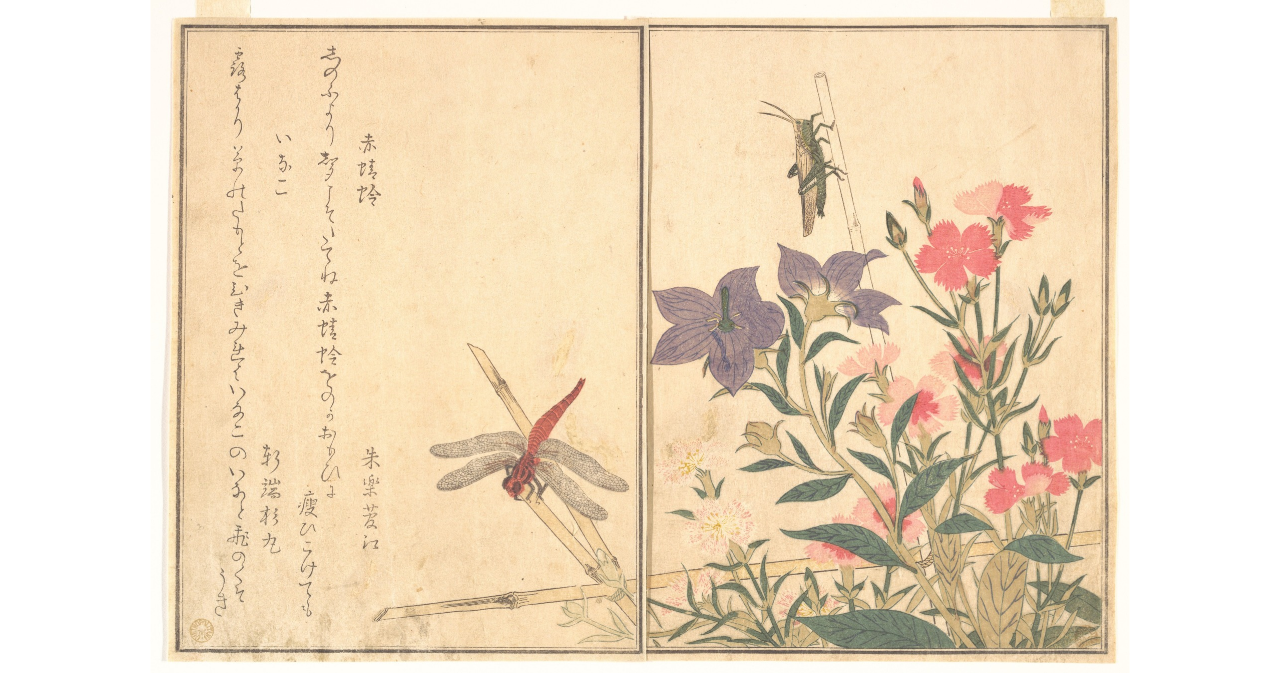
Kaya Shirao (1738-1791, Japan)
Aki no ki no / Autumn begins
.
Aki no ki no
Aka tombo ni
Sadamarinu.
.
The start of Autumn
Is always decided by
The red dragonfly.
_____
Special thanks:
David Bentley Hart (German, Spanish translations)
+ Yelena (Russian translations)
 Zócalo Poets