Winter Solstice poems in Scots and Gaelic
Posted: December 21, 2014 Filed under: English, English: Scots, Gaelic: Scottish Comments Off on Winter Solstice poems in Scots and Gaelic
December Gloaming (poet unknown)
.
In the cauld dreich days when it’s nicht on the back o four,
I try to stick to my wark as lang as may be;
But though I gang close by to the window and glower,
I canna see.
.
But I’m sweir, rale sweir, to be lichtin’ the lamp that early;
And aye I wait whiles there’s ony licht i’ the sky.
Sae I sit by the fire and see there mony a ferly
Till it’s mirk oot-by.
.
But it’s no’ for lang that I sit there, daein’ naething;
For it’s no’ like me to be wastin’ my time i’ the dark;
Though your life be toom, you can aye thank God for ae thing –
There’s aye your wark.
.
But it wadna be wark I wad think o’, if you were aside me.
I wad dream by the ingle neuk, wi’ never a licht;
The glint o’ your een wad be licht eneuch to guide me
The haill forenicht.
.
I wadna speak, for there’s never nae sense in speakin’;
By the lowe o’ the fire I wad look at your bonny hair.
To ken you were near wad be a’ that my her’t wad be seekin’ –
That and nae mair.
. . .
The above poem (December Gloaming) uses Scots Vernacular. Here are a few of its words and phrases with their Standard English counterparts:
dreich = dreary
on the back o four = after 4 p.m.
gang close = stare darkly
sweir = unwilling
mony a ferly = many a strange thing
oot-by = outside
toom = empty
aye = always
ingle neuk = chimney-side
forenicht = evening
lowe = gleam
. . .
William Neill (Prestwick, Ayrshire, Scotland, 1922-2010)
Solstice Wood
.
There is a spinney on the ridge
and I am certain
that it was always there.
When the winter solstice comes
and a red sphere falls behind trees,
I like to think
I am not entirely alone
but that other eyes across time
are with me, and show the same pleasure
that this is the shortest day,
as the druid wheel of the sun
rolls swiftly towards Springtime.
. . .
Solstice Wood, in Neill’s original Gaelic:
Doire A’ Ghrianstad
.
That doire bheag air an druim
is that mi cinnteach,
gu robh i an còmhnaidh ann.
Nuair thig grianstad a’ geamhraidh
is cruinne ruadh a’ tuiteam air cul chraobh
is caomh leam creidsinn
nach eil mi gu tur nam aonar
ach tha sùilean eile thar tìm
maille rium, is an aon tlachd aca
on is e sin an là as giorra
is roth draoidheil na grèine
na rolladh gu luath dhan Earrach.
. . .
Derick Thomson (Ruaraidh MacThòmais)
(Stornoway, Isle of Lewis, Scotland, 1921-2012)
When This Fine Snow is Falling
.
When this fine snow is falling,
climbing quietly to the windows,
dancing on air-currents,
piling itself up against walls
in lovely drifts,
while my son leaps with joy,
I see in his eyes the elation
that every winter brought to my people:
the reflection of snow in my father’s eyes,
and my grandfather as a boy snaring starlings.
.
And I see, through the window of this snowdrift,
and in the glass that dancingly reflects it,
the hill-pass cutting through the generations
that lie between me, on the scree,
and my ancestors, out on the shieling,
herding milk-cows and drinking buttermilk.
I see their houses and fields reflected
on the lonely horizon,
and that is part of my heritage.
.
When their boyhood came to an end
they strove with the land, and ploughed the sea
with the strength of their shoulders,
and worshipped, sometimes;
I spend their strength, for the most part,
Ploughing in the sand.
. . .
When This Fine Snow is Falling, in Thomson’s original Gaelic:
Troimh Uinneig a’ Chithe
.
Nuair that ‘n sneachda min seo a’ tuiteam,
a’ streap gu sàmhach ris na h-uinneagan,
a’ mirean air sruthan na h-iarmailt,
ga chàrnadh fhéin ri gàrraidhean
‘na chithean sàr-mhaiseach,
is mo mhac ‘na leum le aoibhneas,
chì mi ‘na shùilean-san greadhnachas gach geamhradh
a thàinig a riamh air mo dhaoine:
faileas an t-sneachda an sùilean m’ athar,
‘s mo sheanair ‘na bhalach a’ ribeadh dhìdeigean.
.
Is chì mi troimh uinneig a’ chithe seo,
‘s anns an sgàthan that mire ris,
am bealach that bearradh nan linntean
eadar mise, ‘s mi falbh nan sgàirneach,
agus mo shinnsrean, a-muigh air àirigh,
a’ buachailleachd chruidh-bainne ‘s ag òl a’ bhlàthaich.
Chì mi faileas an taighean ‘s am buailtean
air fàire an uaigneis,
‘s that siud mar phàirt de mo dhualchas.
.
Iadsan a’ fàgail staid a’ bhalaich,
‘s a’ strì ri fearann, ‘s a’ treabhadh na mara
le neart an guaillibh,
‘s ag adhradh, air uairibh;
is mise caitheamh an spionnaidh, ach ainneamh,
a’ treabhadh ann an gainneamh.
. . . . .
Poems for Saint Andrew’s Day: Bruce & Neill & Thomson
Posted: November 30, 2014 Filed under: English, English: Scots, Gaelic: Scottish Comments Off on Poems for Saint Andrew’s Day: Bruce & Neill & Thomson
George Bruce (Fraserburgh, Aberdeenshire, 1909-2002)
Why the Poet makes Poems
(written to my dentist, Dr. K. P. Durkacz,
to explain why I failed to keep an appointment)
.
When it’s all done and said
whether he is smithing away by the mad sea,
or, according to repute, silvering them in a garret
by moonlight, or in plush with a gold nib,
or plain bourgeois in a safe bungalow with a mortgage,
or in a place with a name, Paris, Warsaw, Edinburgh,
or sitting with his heart in the Highlands,
or taking time off at the office to pen a few words,
the whole business is a hang-over from the men in the trees,
when thunder and sun and quake and peas in a pod
were magic, and still is according to his book, admitting
botany is OK for the exposition of how the buds got there,
geology for how the rocks got just like that,
zoology for the how of the animals,
biology for us kind – but that’s not his game:
he’s after the lion playing around with the lamb for fun.
He doesn’t want to know the how, the why. It’s enough for him to say:
‘That’s what’s going on. The grass is jumping for joy,
and all the little fishes are laughing their heads off.’
. . .
William Neill (Prestwick, Ayrshire, 1922-2010)
Seasons
.
Skeich wes the hert i the spring o the year
whan the well-sawn yird begoud tae steer
an the plewlan’s promise gledened the ee
atween Balgerran an Balmaghie.
The lang het simmer cam an rowed
the haill Glenkens in a glent o gowd
an the gangan fit on the hill gaed free
atween Balgerran an Balmaghie.
Hairst an the cornriggs flisked i the wun
like a rinnan sea i the southan sun;
then ilka meeda peyed its fee
atween Balgerran an Balmaghie.
Nou the lang year’s dune, an the druim grows stey
an the snaa liggs caal ower Cairnsmore wey;
the crannreuch’s lyart on ilka tree
atween Balgerran an Balmaghie.
. . .
Distant Snow
.
I see in the distance today,
a cloak of snow atop Meall Liath,
Why do I not sae Millyea,
the more Lowland name?
Though there is many a Gaelic name
on the natives of this district
many generations have caused a separation.
Am I blessed or cursed
with too much vision?
. . .
Distant Snow – in the original Gaelic:
Sneachd Air Astar
.
Chi mi an diugh air astar
fallain sneachd air Meall Liath.
Carson nach theirinn Millyea
ainm is motha Gallda?
Ged that iomadh sloinneadh Gàidhlig
air muinntir dùthchasach an àite
rinn iomadh linn eadar-dhealachadh.
Am beannaichte mise no mallaichte
le tuilleadh ‘sa chòir de lèirsinn?
. . .
Larach*
.
On Drumconnard now, only the curlew calls.
Sadly a body may stand on that high place
beside bare gable end and scattered walls
to think of old magic tales and a vanished grace.
.
Foolish, they say, are the praisers of time past:
a wise man turns his face and hails the new,
but bricks of hucksters hall will turn to dust
while Drumconnard’s ruin whispers to the few.
.
*Larach – Gaelic word for ruin or foundation
. . .
Deodorant Advert
(inspired by Catullus’ Latin poem LXIX)
.
Don’t you know, Rufus, why those lovely creatures
won’t let you bed ’em for those gifts laid out
of diamonds, dresses, jewels – things that feature
much in your wooings? There’s a tale about
that says your armpits have a horrid pong
like something dead – and that’s what makes ’em scared.
There’s no good-looking bird will come along
to get her nose filled when your armpit’s bared
– so get some stuff to chase that stink today
or pretty darlings just won’t come your way.
. . .
Deodorant Advert – in Scots:
.
Weill, Roy ma laddie, hou can ye no see
nae bonnie lass will ligg aside yir thie,
for gifts o silen claith an glentin stanes
while yon reek frae yir oxters aye remains?
It stangs yir hairt, ye say, yon nestie tale
that says a gait wad hae a sweeter smell.
Gin oor nebs runkle at yer stink’s rebuff
whit douce wee thing can thole yir manky guff?
Sine oot yon ugsome yowder eidentlie
or dinnae wunner hou the weemin flee.
. . .
Derick Thomson (Lewis/Glasgow, 1921-2012)
Return from Death
.
When I came back from death
it was morning,
the back door was open
and one of the buttons of my shirt had disappeared.
.
I needed to count the grass-blades again,
and the flagstones,
and I got the taste of fresh butter on the potatoes.
.
The car needed petrol,
and love sat sedately on a chair,
and there was an itchy feeling at the back of my knee.
.
And if you believe, as I do,
that one who reads can understand half a word,
you can see that I’ve mentioned
Only a couple of things I felt then.
. . .
Return from Death – in the original Gaelic:
.
Tilleadh Bhon a’ Bhàs
.
Nuair a thàinig mi air ais bhon a bhàs
bha a’ mhadainn ann,
bha an doras-cùil fosgailte,
is bha putan dhe na bha ‘na mo lèine air chall.
.
B’ fheudar dhomh am feur a chùnntadh a-rithist,
is na leacan,
is dh’fhairich mi blas an ìm ùir air a’ bhuntàt’.
.
Bha ‘n càr ag iarraidh peatroil,
‘s an gaol ‘na shuidhe gu stòlda air seuthar,
is tachais anns an iosgaid agam.
.
‘S ma tha thu creidse mar tha mise
gun tuig fear-leughaidh leth-fhacal,
chì thu nach tug mi iomradh
ach air rud no dhà a dh’ fhairich mi.
. . . . .
Nua-bhàrdachd: Gàidhlig / Contemporary Gaelic poetry from Scotland: Meg Bateman
Posted: November 30, 2012 Filed under: English, Gaelic: Scottish, Meg Bateman Comments Off on Nua-bhàrdachd: Gàidhlig / Contemporary Gaelic poetry from Scotland: Meg Bateman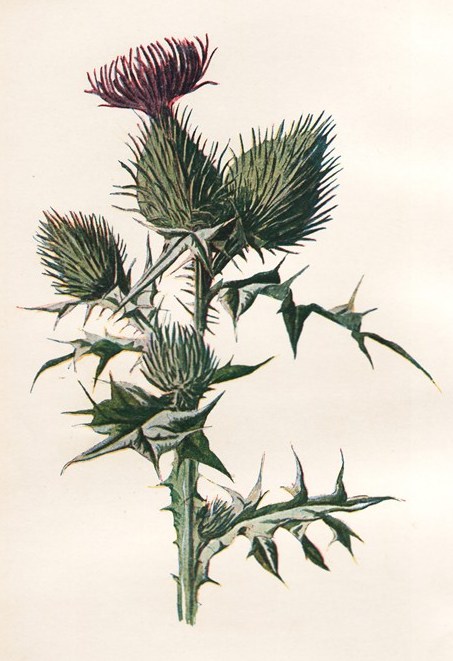
ZP_A nineteenth-century illustration, Spear-plume thistle or Cirsium vulgare, which was the original native Scotch Thistle until the arrival in the middle ages of the tougher, spinier and more impressive Onopordum acanthium.
Meg Bateman (born 1959, Edinburgh, Scotland)
“Mother”
.
We looked at the stars for a while
Before we turned in with the dogs,
And you said it was high time
You learnt their names properly.
.
But soon you will be among them yourself
And I will be the one trying to name you;
You whose nature I have seen
Only as their faint points of light –
.
As you labour behind duty,
Behind house-work, farm-work, books,
And who knows if you have your reward
For your care and effort and exhaustion.
.
I wish I could kindle a joy in you
That would let me see you whole
Or you won’t be further when you go
Than you were tonight at my side.
. . .
“Màthair”
.
Bha sinn a’coimhead nan rionnag
mus do thionndaidh sinn a-steach leis na coin,
is thuirt thu gum bu mhithich dhut
na h-ainmean aca ionnsachadh gu ceart.
.
Ach chan fhada gus am bi thu fhèin nam measg
’s is mise a bhios a’feuchainn ri d’ainmeachadh,
thusa aig nach fhaca mi do nàdar
ach mar phriobadh fann an cuid solais –
.
Is tu riamh an ceann do dhleastanais,
mu chòcaireachd, caoraich, leabhraichean;
a bheil fios an d’fhuair thu do dhìol
airson do dheataim is spàirn is sgìths?
.
O gun lasainn de dh’aighear annad
na leigeadh leam d’fhaicinn gu slàn,
no chan fhaide thu bhuam nuair a shiùbhlas tu
nab ha thu rim thaobh a-nochd.
. . .
“Lightness”
.
It was your lightness that drew me,
The lightness of your talk and your laughter,
The lightness of your cheek in my hands,
Your sweet gentle modest lightness;
And it is the lightness of your kiss
That is starving my mouth,
And the lightness of your embrace
That will let me go adrift.
. . .
“Aotromachd”
.
B’ e d’ aotromachd a rinn mo thaladh,
Aotromachd do chainnte’s do ghaire,
Aotromachd do lethchinn nam lamhan,
D’ aotromachd lurach ur mhalda;
Agus ‘s e aotromachd do phoige
A tha a’ cur trasg air mo bheoil-sa,
Is ‘s e aotromachd do ghlaic mum chuairt-sa
A leigeas seachad leis an t-sruth mi.
. . .
“O Bonnie Man, Lovely Man”
.
O bonnie man, lovely man,
You’ve brought a song to my lips,
.
A spring of clear gushing water
Spilling over the rocks,
.
Soft grasses and bracken
Covering my slopes with green;
.
Your bed is in cotton-grass
With curlews calling in flight,
.
Maytime’s sweet drizzle
is settling about me,
.
Giving mirth and voice
to my soils long barren,
.
O bonnie man, lovely man,
You’ve brought a song to my lips.
. . .
“Fhir luraich ’s fhir àlainn”
.
Fhir luraich ’s fhir àlainn,
thug thu dàn gu mo bhilean,
.
Tobar uisge ghil chraobhaich
a’ taomadh thar nan creagan,
.
Feur caoin agus raineach
a’ glasadh mo shliosan;
.
Tha do leabaidh sa chanach,
gairm ghuilbneach air iteig.
.
Tha ceòban cùbhraidh na Màighe
a’ teàrnadh mu mo thimcheall,
.
’S e a’ toirt suilt agus gutha
dham fhuinn fada dìomhain,
.
Fhir luraich ’s fhir àlainn,
thug thu dàn gu mo bhilean.
. . . . .
All poems © Meg Bateman
Latha Naomh Anndra / Scottish Gaelic poems for Saint Andrew’s Day: Sorley Maclean
Posted: November 30, 2012 Filed under: English, Gaelic: Scottish, Sorley Maclean Comments Off on Latha Naomh Anndra / Scottish Gaelic poems for Saint Andrew’s Day: Sorley Maclean.
Sorley Maclean (Somhairle MacGill-Eain)
(Raasay, Scotland, 1911-1996)
“Should I even strip off…”
.
Should I even strip off
My deceit-proof clothing
And go naked and eager
As a blaze of supreme reason,
I’d then reach the core-love
Of my reason for living
And I’d add to your pleasure
The blaze of supreme reason.
. . .
“Ged chuirinn dhiom éideadh”
.
Ged chuirinn dhiom éideadh
Faireachaidh na cluaineis
‘S nam falbhainn 10m gleusta
‘Nam chaoir céille buadhmhoir,
Ruiginn an-sin cré-ghaol
Mo chéille luaidhe
‘S liùbhrainn do t’ éibhneas
Caoir na céille buadhmhoir.
. . .
“Calvary”
.
My eye is not on Calvary
nor on Bethlehem the Blessed,
but on a foul-smelling backland in Glasgow,
where life rots as it grows;
and on a room in Edinburgh,
a room of poverty and pain,
where the diseased infant
writhes and wallows till death.
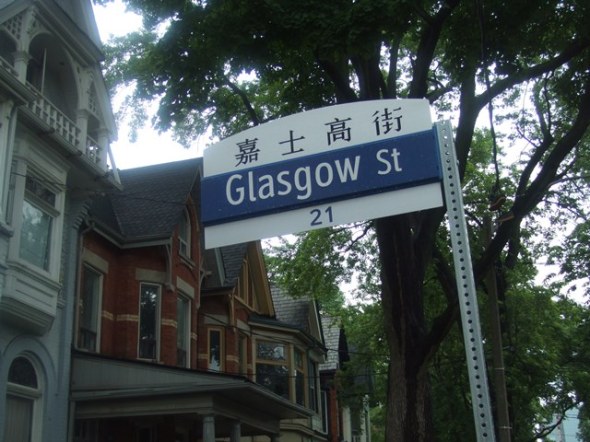
ZP_Glasgow Street, Toronto, Canada
“Calbharaigh”
.
Chan eil mo shùil air Calbharaigh
no air Betlehem an àigh
ach air cùil ghrod an Glaschu
far bheil an lobhadh fàis,
agus air seòmar an Dùn Èideann,
seòmar bochdainn ’s cràidh,
far a bheil an naoidhean creuchdach
ri aonagraich gu bhàs.
. . .
“The Choice”
.
I walked with my reason
out beside the sea.
We were together but it was
keeping a little distance from me.
.
Then it turned saying:
is it true you heard
that your beautiful white love
is getting married early on Monday?
.
I checked the heart that was rising
in my torn swift breast
and I said: most likely;
why should I lie about it?
.
How should I think that I would grab
the radiant golden star,
that I would catch it and put it
prudently in my pocket?
.
I did not take a cross’s death
in the hard extremity of Spain
and how then should I expect
the one new prize of fate?
.
I followed only a way
that was small, mean, low, dry, lukewarm,
and how then should I meet
the thunderbolt of love?
.
But if I had the choice again
and stood on that headland,
I would leap from heaven or hell
with a whole spirit and heart.
. . .
“An Roghainn”
.
Choisich mi cuide ri mo thuigse
a-muigh ri taobh a’ chuain;
bha sinn còmhla ach bha ise
a’ fuireach tiotan bhuam.
.
An sin thionndaidh i ag ràdha:
a bheil e fìor gun cual’
thu gu bheil do ghaol geal àlainn
a’ pòsadh tràth Diluain?
.
Bhac mi ’n cridhe bha ’g èirigh
’nam bhroilleach reubte luath
is thubhairt mi: tha mi cinnteach;
carson bu bhreug e bhuam?
.
Ciamar a smaoinichinn gun glacainn
an rionnag leugach òir,
gum beirinn oirre ’s gun cuirinn i
gu ciallach ’na mo phòc?
.
Cha d’ ghabh mise bàs croinn-ceusaidh
an èiginn chruaidh na Spàinn
is ciamar sin bhiodh dùil agam
ri aon duais ùir an dàin?
.
Cha do lean mi ach an t-slighe chrìon
bheag ìosal thioram thlàth,
is ciamar sin a choinnichinn
ri beithir-theine ghràidh?
.
Ach nan robh ’n roghainn rithist dhomh
’s mi ’m sheasamh air an àird,
leumainn à neamh no iutharna
le spiorad ’s cridhe slàn.
. . . . .
“In all its breadth and ceaseless treasure”: the Contemporary Gaelic Poems of Lewis MacKinnon
Posted: November 30, 2011 Filed under: English, Gaelic: Scottish, In all its breadth and ceaseless treasure: Lewis MacKinnon and the contemporary Gaelic poem, Lewis MacKinnon Comments Off on “In all its breadth and ceaseless treasure”: the Contemporary Gaelic Poems of Lewis MacKinnon
Gaelic-language poems by Lewis MacKinnon:
Your Speech
Listening to your speech today;
A bag-of-wind speech,
A speech without ceasing,
A speech without shape,
A speech without feeling,
A speech without essence,
A speech without a path,
A speech as crazy as the birds,
A speech that was not heard,
A speech no one noticed,
A speech bawling out in the cold wind,
A speech alone, forgotten,
A speech misunderstood,
A speech calling out for aid,
A beautiful, meek, melodious, open speech, without blemish;
_____
A’ Chainnt Agad
Ag éisdeachd ris a’ chainnt agad
an diugh;
Cainnt ghuthmhor
Cainnt gun stad
Cainnt gun chruth
Cainnt gun fhaireachdainn
Cainnt gun bhrìgh
Cainnt gun rathad
Cainnt cho gòrach ri eòin nan speuran
Cainnt nach deach a chluinntinn
Cainnt air nach d’ thug neach-eiginn aire
Cainnt ag éibheachd ‘san t-soirbheas fhuar
Cainnt ‘na h-aonar, air a dìochuimhneachadh
Cainnt nach deach a tuigsinn
Cainnt ag gairm oirnn airson cuideachaidh,
Cainnt bhriagha, mhacanta, bhinn, fhosgarra, gun smal
____
Institutional Thoughts
Through the looking glass of faith
and the remains of empires,
and the institutions built by these,
a person arrives at this place in time and being;
Where the creed of his belief and the learning of colonizers
influences his every deed;
Even when he is sitting in some meeting or other
and struggling in his mind against ideas and words;
That someone else is putting forward;
Struggling for no real cause whatsoever;
But the fear of the loss of control;
That lurks under the surface of the legacy,
those institutions left from long ago;
_____
Smuaintean Air Stéidhichidhean
Troimh ghloine-seallaidh a’ chreideimh agus
fuigheall nan Ìmpireachdan,
is na stéidhichidhean a chaidh a thogail leotha,
ruigidh duin’ an t-àite seo ann an àm agus bith;
Far an toir creud a’ chreideis aig’ agus ionnsachadh
a’ luchd-ionnsaidh buaidh do gach
gnìomh a nì e;
Fìu ‘s nuair a tha e ‘na shuidhe ann an coinneimh air
choireigin
a’ dèanadh strì ‘na inntinn an aghaidh bheachdan is fhaclan;
A tha cuideigin eile a’ cur air adhart;
A’ dèanadh strì gun fhìor adhbhar sam bith;
Ach eagal call a’ smachd a tha fo uachdar na dìleib,
a dh’ fhàg na stéidhichidhean seo bho chionn fhada;
_____
Facebook and Gaelic
Writing in an unknown language,
old, shaky, alone,
in order that people will have a mere knowledge of it;
I write in this loneliness,
and I often suppose that there isn’t one person
on the surface of the earth,
that is in the same situation as me;
But I paused and I thought about the whole thing;
And then, it struck me
that Facebook
is kind of like Gaelic;
And I decided
that I would offer
Facebook the Gaelic language,
to be a friend to it,
in all its breadth
and ceaseless treasure;
And instead of being afraid
of an intrusion in its personal life
I welcome
any and all scrutinizing
that can be done of it
And I’ll provide Facebook
its date of birth,
its religious persuasion,
its sexual orientation,
its life history,
its stories,
its music,
its customs,
its expressions,
its hobbies,
its hopes,
its fears,
its musical interests,
where it was raised,
and what it is up to at this very moment
_____
Làrach Nan Ceanglaichean Agus A’ Ghàidhlig
A’ sgrìobhadh ann an cànain neo-aithnichte
sean, cugallach, aonaranach,
airson ‘s gum bi beagan eòlais aig daoin’ oirre
Is mar a sgrìobhas mi ‘san aonaranachas seo
gu tric saoilidh mi nach eil aon duin’ eile
air uachdar an t-saoghail
‘san aon suidheachadh ‘s a tha mise
Ach stad mi is smaointich mi
air a’ ghnothach
Is a’ sin, bhuail orm
gu bheil Làrach nan Ceanglaichean
car coltach ris a’ Ghàidhlig;
Agus chuir mi romham
gun tairginn-sa do Làrach nan Ceanglaichean
a’ Ghàidhlig,
a bhith ‘na caraid dhi,
‘na farsaingeachd air fad
‘na stóras gun chrìch
Agus an àite a bhith fo eagal
air foirneachd a beatha phearsanta
cuiridh mi fàilte air
sgrùdadh sam bith a théid a dhèanadh oirre
Agus bheir mi
ceann-là a breith,
a creideamh gneitheach,
a gné,
eachdraidh a beatha,
a sgeulachdan,
a h-òrain,
a ceòl,
a cleachdaidhean,
a gnàthsan-chainnt,
na cur-seachadan aice,
a dòchasan,
a h-eagail,
a sùim ciùil,
far an deach a togail,
is gu dé tha i ris an dràsda-fhéin
_____
A Fart
Now drawing the last gasp
and dying;
Free, unfettered, finally;
From the beliefs of people
who think that you died,
long ago;
But surprisingly,
you are still kicking in the hidden coffin,
with very little of your ancient little-known breath remaining;
And similar to a fart that is made someplace,
that is too confining,
and the smell wafts about choking everyone that is there,
and making them uncomfortable with shame,
You keep unexpectedly appearing;
And there are still those,
that are going around,
with their hands
tightly gripped on their noses;
Afraid of these little wiffs
that disperse;
You know that attitude you get
and how it’s shouted out, “Who did that anyway?”
And despite an immeasurable lack of attention,
you continue to fall out,
just like that fart,
that comes without welcome, without warning
_____
Braoim
A-nist a’ tarraing na h-uspaig mu dheireadh
is ag eugachdainn;
Saor, gun bhannan mu dheireadh thall;
O bheachdan dhaoine
a tha ‘smaoineachadh gun do dh’ eug thu,
o chionn iomadach bliadhna;
Ach gu h-iongantach,
tha thu fhathast air crith ‘sa’ chistidh fhalaichte seo,
le glé bheag dhen anail aosda neo-aithnicht’ agad air fhàgail,
Is mar bhraoim a chaidh a dhèanadh an àiteigin
a bha tuilleadh ‘s seasgair,
is a’ fàileadh a’ flodradh mun cuairt
a’ tachdadh a h-uile duin’ ann,
is ‘gan dèanadh mì-chomhfhurtail,
fo nàire;
Tha thu an còmhnaidh gun fhios a’ nochdadh;
Agus tha feadhainn ann,
a tha ‘dol air adhart fhathast,
leis na làmhan aca,
le fìor ghréim air an sròin;
Fo eagal nan oiteagan beaga seo,
a théid an sgapadh;
Fhios agad a’ freagairt a gheobh thu,
“Có rinn sin co-dhiubh?”
Agus a dh’ aindeoin cion-aire gun mheud,
théid agad air tuiteam a-mach,
dìreach mar a thuiteas am braoim ud,
a thig gun fhàilte, gun rabhadh
_____
Limited Pieces
I would like to meet with you again
one day,
where there is nothing between us,
but the awareness of one another;
Far away from the field of memory,
where there aren’t,
Memories
Experiences
Beliefs
Judgements
Pre-meditations
Or feelings
And there we can meet again
Since I would like to give, the pieces of you,
that do not completely constitute any of those above,
that I have been keeping so close to me,
for so long,
back to you
_____
Criomagan Beaga
Bu mhath leam coinneachadh riut
là air choireigin,
far nach eil sion sam bith ann eadarainn,
ach an t-eòlas air ré an duin’ eile;
Fad air falbh o’ phàirc a’ chuimhne
far nach eil
Cuimhnichean
Féin-fhiosrachaidhean
Creideamhan
Breitheanais
Beachdan a bh’ ann roimhe
No faireachdainnean
Is a’ sin faodaidh sinn coinneachadh a-rithist
A chionn ‘s bu mhath leam na criomagan dhìot
nach dèan suas gu h-iomlan gin dhen fheadhainn gu h-àrd,
a tha mi ‘gléidheadh cho dlùth dhomh,
fad an t-saoghail,
a thoirt air ais dhut
_____
Innards
I dug you out from the shape of your human body
And I looked at you sincerely;
To see if I could find
Out what was bothering you;
You, lamenting the deeds that you committed
And all your passions
With the hope that you would have another chance
To go back
And put things right;
In order to get some relief
You permitted me to search your insides;
You never uttered a word
When I went in
At ease, peaceful
Somehow content
That you were finally
Getting some attention
For the painful burden you
Were carrying;
And in I went
And I started
And God all mighty If I am not still there
Lost in your complexity;
Mionach
Chladhaich mi thu a-mach á cruth daonna na bothaig agad
Agus choimhead mi ort gu fìrinneach
Fiach a gheobhainn a-mach
Gu dé bha ‘cur ort
Thusa ‘caoineadh nan gnìomhan a rinn thu
Is na mianntan uile agad
Leis an dòchas gum biodh seans’ eile agad
A dhol air ais
A chur rudan ceart
Gus faothachadh ‘fhaighinn
Leig thu dhomh lorg ‘nad bhroinn
Cha d’ thuirt thu guth
Nuair a chaidh mi a-staigh
Socair, ciùin,
Is leig thu dhomh do mhionach a bhuntainn
Dòigh air choireiginn
Toilichte
Gu robh thu mu dheireadh thall
A’ faighinn air’ air an uallach phianail
A bha thu air giùlain
Chaidh mi a-staigh
Is thòisich mi
Is a Dhia nan gràsan nach eil mi fhathast ann
Air chall ‘san iom-fhillteachd agad
_____*_____*_____
Lewis MacKinnon (Lodaidh Macfhionghain) was born in 1970
in Inverness, Cape Breton, Nova Scotia, Canada.
Son of a Gaelic-speaking father and a French-Acadian mother, he is
an accomplished singer/songwriter as well as a poet.
His poems featured here were composed in Gaelic – using Nova Scotian
Gaelic’s spelling and punctuation, not Scottish Gaelic’s – then translated /
interpreted into English by the author himself.
Two of the poems, “Limited Pieces” and “Innards”, are exquisite in their
subtle intensity and candour – among the best love poems by any
Canadian poet.
MacKinnon’s 2008 book of poems, Giant and other Gaelic Poems /
Famhair agus dàin Ghàidhlig eile, includes 89 poems in Gaelic
with English versions.
 Zócalo Poets