“In Flanders Fields”: the Remembrance Day poem – in five languages
Posted: November 11, 2015 Filed under: Arabic, English, French, German, John McCrae, Spanish | Tags: Poemas para el Día del Recuerdo Comments Off on “In Flanders Fields”: the Remembrance Day poem – in five languages
“In Flanders Fields”: the Remembrance Day poem – in five languages…
In French:
John McCrae (1872-1918)
Dans les champs de Flandres
.
Dans les champs de Flandres les coquelicots sont en fleurs
entre les croix, rang par rang
ça marque notre place, et dans le ciel
les alouettes, chantent toujours bravement, volent
rarement entendues par les fusils en bas.
Nous sommes les Morts. Il y a peu de temps,
nous vivions, sentions le crépuscule, regardions le soleil couchant,
aimions, et étions aimés, et maintenant nous sommes allongés
dans les champs de Flandres.
Admets notre dispute aven l’ennemi;
pour toi de nos mains blessées, nous jetons
le flambeau à ton tour de relever
si tu n’as pas confiance en nous qui sommes morts
nous ne dormirons plus, bien que les coquelicots poussant
dans les champs de Flandres.
. . .
In Spanish:
John McCrae
(poeta-médico-soldado canadiense,
nacido en Guelph, Ontario, Canadá, 1872 – falleció 1918, en Francia)
En los campos de Flandes
.
Se mueven las amapolas
entre las filas de cruces,
que señalan nuestro sitio;
y en el cielo las alondras,
cantan desafiantes pese a todo,
vuelan oyendo apenas los cañones de abajo.
Somos los Muertos.
Hace pocos días vivíamos,
sentíamos el amanecer,
veíamos el brillo del crepúsculo,
amábamos y éramos amados,
y ahora yacemos en los campos de Flandes.
.
Haz tuya nuestra lucha contra el enemigo:
a ti pasamos la antorcha desde nuestras desfallecidas manos;
hazla tuya para mantenerla en alto.
Si faltas a la palabra que diste a los que morimos
no dormiremos, aunque crezcan las amapolas
en los campos de Flandes.
. . .
“In Flanders Fields” es un poema de guerra en forma de rondó escrito durante la Primera Guerra Mundial por John McCrae perteneciente al Cuerpo Expedicionario Canadiense desplegado en Flandes. McCrae quedó muy afectado por la muerte de su amigo (y antiguo alumno) teniente Alexis Helmer durante la Segunda Batalla de Ypres. Al día siguiente, 3 de mayo de 1915, McCrae, inspirado por la muerte de Helmer junto con tantos otros soldados y observando la cantidad de amapolas que crecían entre las cruces de los caídos, escribió “In Flanders Fields”. El poema fue publicado sin firmar y por primera vez en la revista londinense Punch del 8 de diciembre de 1915.
. . .
John McCrae
In Flanders Fields (composed in May of 1915 — this is the original poem)
.
In Flanders fields the poppies blow
Between the crosses, row on row,
That mark our place; and in the sky
The larks, still bravely singing, fly
Scarce heard amid the guns below.
.
We are the Dead. Short days ago
We lived, felt dawn, saw sunset glow,
Loved and were loved, and now we lie
In Flanders fields.
.
Take up our quarrel with the foe:
To you from failing hands we throw
The torch; be yours to hold it high.
If ye break faith with us who die
We shall not sleep, though poppies grow
In Flanders fields.
. . .
In Arabic:
In Flanders fields the poppies blow
في حقول الفلاندرز يزهر الخشخاش
Between the crosses, row on row,
بين الصًّلبان المرصوفة صفّـاً صـفّاً،
That mark our place; and in the sky
ذاك هو علامة مكاننا؛ وفي السَّماء
The larks, still bravely singing, fly
ما تزال القبّرات، مترنِّمة دون وجل، تطير
Scarce heard amid the guns below.
لا تكادُ تُسمَعُ وسط أصوات البنادق تحت !
We are the Dead. Short days ago
نحن الأمواتُ. وقبل أيامٍ قلائـلَ،
We lived, felt dawn, saw sunset glow,
كنا أحياءً، أحسسْنا بالفجر، رأينا الأصيل يتألّق
Loved and were loved, and now we lie
أحبَبْنا وأُحبِبْنا، والآن نضطجع
In Flanders fields.
في حقول الفلاندرز.
Take up our quarrel with the foe
تابعوا معركتنا مع العدوّ
To you from failing hands we throw
من أيدٍ خائراتٍ نرمي الشعلة إليكمْ؛
The torch; be yours to hold it high.
وليكنْ لكم لترفعوه عالياً.
If ye break faith with us who die
وإنْ نقضتم العهدَ، نحنُ الذين نموت،
We shall not sleep, though poppies grow
فلا ننام ، ولو أنّ الخشخاش يتكاثـرُ
In Flanders fields
في حقول الفلاندرز.
انظر أيضًا
. . .
In German:
John McCrae
Auf Flanderns Feldern
.
Auf Flanderns Feldern blüht der Mohn
zwischen Reihen von Kreuzen,
wo unser letzter Ruheplatz ist; und am Himmel
fliegen immer noch die prächtig singenden Lerchen;
kaum hörte man ihren Gesang unten bei den Geschützen
Wir sind die Toten. Vor kurzem noch
lebten wir, nahmen die Morgendämmerung wahr;
liebten und wurden geliebt. Und jetzt liegen wir
auf Flanderns Feldern.
Führt unseren Kampf mit dem Gegner fort!
Euch werfen wir aus kraftlosen Händen
die Fackel zu; sie hoch zu tragen sei eure Pflicht.
Haltet ihr uns Toten nicht die Treue,
werden wir nicht ruhen, auch wenn der Mohn blüht
auf Flanderns Feldern.
. . . . .
Muharram Mubarak: poem for a blesséd New Year المحرّم
Posted: November 15, 2012 Filed under: Arabic, English Comments Off on Muharram Mubarak: poem for a blesséd New Year المحرّم
New Year’s Resolutions:
a poem by Wayfarer
.
The first of Muharram has arrived
– Alhamdulillah –
Another year we have survived
This year we strive to do so much better
Practice our Deen down to the letter
Complete all our Salaat on time
Do many good deeds in our prime
Give Zakat without hesitation
Of the Holy Qu’ran make frequent recitation
Treat all we come across with kindness
Constantly ask for forgiveness
Muharram Mubarak to you, and
May all your Duas come true
– Insha’Allah !
. . .
Glossary of Arabic phrases and Muslim terms:
Alhamdulillah: In Arabic – God/Allah be praised
Deen: In Arabic – the way or code of life
Salaat: Arabic for proper prayer ritual
Zakat: the giving of a portion of one’s wealth to the poor or needy – a practice initiated by Muhammad
Muharram Mubarak: Blesséd Muharram – an equivalent to Happy New Year in English. Muharram is the first month of the Islamic lunar calendar. In 2012 New Year’s Day is November 15th and marks the beginning of year 1434.
Dua: calling out to/summoning God – one’s personal invocation to Allah
Insha’Allah: In Arabic – God/Allah willing, If God/Allah wishes it to be so.
.
A special Thank You to Wayfarer for this Muharram poem!
. . . . .
Remembrance Day: poems about Palestine, Iraq, Afghanistan
Posted: November 11, 2012 Filed under: Arabic, Dunya Mikhail, English, Mahmoud Darwish | Tags: Remembrance Day poems Comments Off on Remembrance Day: poems about Palestine, Iraq, Afghanistan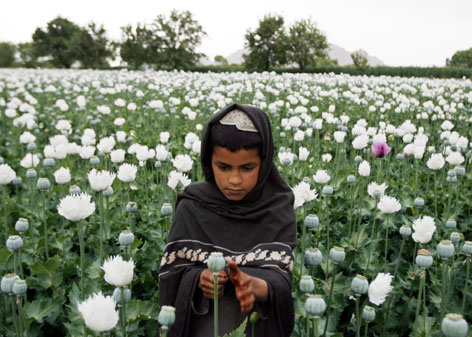
Mahmoud Darwish (born 1941, Palestine/Israel, died 2008, USA)
“I am from there”
.
I am from there and I have memories.
Like any other man I was born, I have a mother,
A house with several windows, friends and brothers.
I have a prison cell’s cold window, a wave
Snatched by seagulls, my own view, an extra blade
Of grass, a moon at word’s end, a life-supply
Of birds, and an olive tree that cannot die.
I walked and crossed the land before the cross
Of swords banqueted on what its body was.
.
I come from there, and I return the sky
To its mother when it cries for her, and cry
For a cloud on its return to recognize me.
I have learned all words befitting of blood’s court to break
The rule; I have learned all the words to take
The lexicon apart for one noun’s sake,
The compound I must make:
Homeland.
Sami Mahdi
Poems from “War Diaries”
(translated from Arabic by Ferial J Ghazoul)
.
I (Feb.14th 1991)
From gazelles’ eyes the pupils dropped
When the bridge was bombed
Lovers’ rings shattered
And mothers were bewildered.
.
II (Feb.16th 1991)
With fire we perform our ablutions every morning
Collecting our remnants
And the debris of our houses
We purge our souls with the blood of our wounds.
.
III (Feb.24th 1991)
Plenty we have received
What shall we offer you, O land of patient destitutes?
Plenty we have received
So receive us
And pave with us the paths of wayfarers.
.
Sami Mahdi (born 1940, Iraq) wrote the above poems about the Gulf War (1990-1991) when he was living in Baghdad and working as editor of an Iraqi daily newspaper.
. . .
Dunya Mikhail (born 1965, Baghdad, Iraq, now living in the USA)
“The Prisoner”
(translated from Arabic by Salaam Yousif and Elizabeth Winslow)
.
She doesn’t understand
what it means to be “guilty”
She waits at the prison door
until she sees him
to tell him “Take care”
as she used to remind him
when he was going to school
when he was going to work
when he was going on vacation
She doesn’t understand
what they are uttering now
those who are behind the bar
with their uniforms
as they decided that
he should be put there
with strangers in gloomy days
It never came to her mind
when she was saying lullabies
upon his bed
during those faraway nights
that he would be put
in this cold place
without moons or windows
She doesn’t understand
The mother of the prisoner doesn’t understand
why should she leave him
just because “the visit has finished” !
(2003)
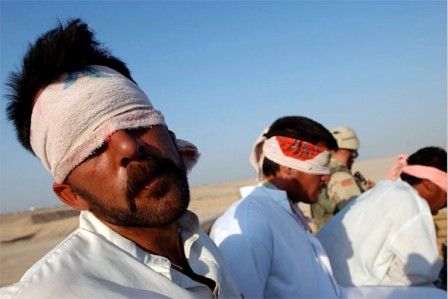
“The War works hard”
(translated from Arabic by Elizabeth Winslow)
.
How magnificent the war is!
How eager
and efficient!
Early in the morning
it wakes up the sirens
and dispatches ambulances
to various places
swings corpses through the air
rolls stretchers to the wounded
summons rain
from the eyes of mothers
digs into the earth
dislodging many things
from under the ruins…
Some are lifeless and glistening
others are pale and still throbbing…
It produces the most questions
in the minds of children
entertains the gods
by shooting fireworks and missiles
into the sky
sows mines in the fields
and reaps punctures and blisters
urges families to emigrate
stands beside the clergymen
as they curse the devil
(poor devil, he remains
with one hand in the searing fire)…
The war continues working, day and night.
It inspires tyrants
to deliver long speeches
awards medals to generals
and themes to poets
it contributes to the industry
of artificial limbs
provides food for flies
adds pages to the history books
achieves equality
between killer and killed
teaches lovers to write letters
accustoms young women to waiting
fills the newspapers
with articles and pictures
builds new houses
for the orphans
invigorates the coffin makers
gives grave diggers
a pat on the back
and paints a smile on the leader’s face.
It works with unparalleled diligence!
Yet no one gives it
a word of praise.
(2003)
.
Dunya Mikhail’s poem “The War works hard” has been described as being not about a specific war – although it could easily be about The Iraq War (2003-2011) – but rather “about War itself, seemingly a force as insistent and powerful as Life, in fact the very motor of human history. The poet’s verbs (“works” “sows”, “reaps”, “teaches”, “paints”) work rhetorically to make war seem like any other worthwhile human activity. Her (Mikhail’s) speaking voice exhibits not the slightest trace of shock, but in doing so forces the reader into shock…”
. . .
Alex Cockers
The Brutal Game
.
I’m sitting here now
Trying to put pen to paper
Trying to write something
That you can relate to.
.
It’s hard to relate
To my personal circumstances
I’m out here in Afghanistan now
Taking my chances.
.
Read what you read
And say what you say
You won’t understand it
Until you’ve lived it day by day.
.
Poverty-stricken people
With mediaeval ways
Will take your life without a thought.
.
And now we’re all the same
Each playing our part in this brutal game.
. . .
Morals……two for a pound
.
I’ve been and seen
And feel slightly unclean
About the things I’ve done
Under a hot sun.
.
Away in a place
The British public don’t understand
A place where every day
Man kills fellow man.
.
Is it right to fight
In an unjust war?
Well I don’t have a choice
And peace is such a bore.
.
Being paid tuppence
To put my life on the line
Trying to pretend
That everything is fine.
. . .
Alex Cockers (born 1985, UK) was a Royal Marines Commando from 2005 to 2009. He served in Helmand province, Afghanistan, for fourteen months. He explains:
” I had many feelings and thoughts that I was unable to share with anyone…Under the stars in the desert, rhymes would manifest in my head. I would write them down, construct them into poems and somehow I felt better for getting it off my chest. ”
. . . . .
Speak speak, that we may know the end of this travelling: Mahmoud Darwish محمود درويش
Posted: April 7, 2012 Filed under: Arabic, English, Mahmoud Darwish Comments Off on Speak speak, that we may know the end of this travelling: Mahmoud Darwish محمود درويشWe are grateful to A. Z. Foreman for the following translation from Arabic into English.
Visit his site: http://www.poemsintranslation.blogspot.com
_____
Mahmoud Darwish / محمود درويش
(Palestine/Israel,1941-2008)
We travel like anyone else
We travel like anyone else, but do not return to anything
as if travelling
Were the way of the clouds. We buried our loved ones deep
in the shadow of the clouds and among the trunks of the trees.
We told our wives: give birth by us for centuries,
that we may complete this journey and see
A moment of a country, a meter of what can’t be.
In the carriages of the psalms we travel, in the tent of the prophets we sleep,
we come out of the words the gypsies speak.
We measure space with a hoopoe’s beak
or sing to while the distance away or wash the moonlight clear.
Long is your path, so dream of seven women to bear this long path on
Your shoulders. Shake the palmtree for each one
to know her name and which shall be
the mother of the boy from Galilee*.
Ours is a country of words. Speak, speak,
that I may lay my road on stone of stone to something.
Ours is a country of words. Speak speak
that we may know the end of this travelling.
* “the mother of the boy from Galilee”
refers to Mary, mother of Jesus
Poem for the Man of Light: Abdul Wahhab Al-Bayati
Posted: November 16, 2011 Filed under: Abdul Wahhab Al-Bayati, Arabic, English Comments Off on Poem for the Man of Light: Abdul Wahhab Al-Bayati_____
The man of light
Goes vagrant through my sleep at night
He stops in the abandoned corner
To extract words from my memory to write
And rewrite them aloud,
To blot lines out
He looks into the mirror
Of the house sunken deep in the darklight.
He recollects something
And slinks from my sleep.
I wake in dread
And try to recollect some thing
Of what he wrote, of what was said,
In vain. For the light
Has erased the papers and my memory
With daybreak’s deadman white.
*
We are grateful to A. Z. Foreman for his translation from the Arabic into English.
Visit his site: poemsintranslation.blogspot.com
Abdul Wahhab Al-Bayati (1926-1999) was an Iraqi poet who modernized Arabic poetry, introducing broader topics and breaking with the classical tradition of strict rhyme and metre.
The Arabic original of the poem follows:
قصيدة لرجل النور
عبد الوهاب البياتي
يتجول في نومي رجل النور
يتوقف في الركن المهجور
يُخرج من ذاكرتي كلماتٍ
يكتبها
ويعيد كتابتها في صوت مسموع
يمحو بعض سطور
ينظر في مرآة البيت الغارق بالظلمة والنور
يتذكر شيئاً
فيغادر نومي
استيقظ مذعوراً
وأحاول أن أتذكر شيئاً
مما قال ومما هو مكتوب
عبثاً ، فالنور
مسح الأوراق وذاكرتي
ببياض الفجر المقتول
Nawal Naffaa: “Slip”
Posted: October 2, 2011 Filed under: Arabic, English, Nawal Naffaa Comments Off on Nawal Naffaa: “Slip”_____
“Slip”
I count up the corpses and aircraft
Falling in pieces from the news
I count the bullets that are exhumed,
The bullets that are buried
And the bullets preparing
To be shot loose.
I follow the ritual of food.
I finish my plate
By eating the plate
After a backbreaking day of the work I do.
When did I get this heartless?
Tomorrow, I’ll make room in a corner of your chest
Where I can cry
And I just might exhume the corpse out of my chest
And prepare a ritual
Of proper burial.
اعُدّ الجثث والطائرات
المتساقطة من نشرات الاخبار
اعد الرصاصات المنزوعة
الرصاصات المدفونة
والرصاصات الجاهزة
للاطلاق
واتابع طقوس الطَعام
آتي على الطبق
آكل الطبق
بعد يوم عمل شاق!
متى اصبحت قاسية هكذا؟
غداً أفسِحُ لي ركناً في صدركَ
كي ابكي هناك
فقد انزِع الجثث من صدري
وأُعِدّ طقوساً لائقةً لدفنها

_____
Palestinian poet Nawal Naffaa was born in 1970.
She writes in Arabic.
To create in two “languages” – painting and poetry – holds
great meaning for her and she often strives to merge the two
via “painting within writing – using metaphor in poetry”.
“Slip” captures – in strong, simple metaphors – the
“stunning” effectiveness, the “numbing” capability,
in acts of war.
*
For this translation from Arabic into English
we are grateful to A. Z. Foreman.
Visit his site: http://www.poemsintranslation.blogspot.com
 Zócalo Poets